Losing is never
acceptable. When is a Celtic 5-0 home loss to Paris St Germain a
matter for Pride?
They came, we all
saw, we lost. But, in defeat, we remain “unconquered”.
What rambling
nonsense is this?
Well, firstly, this
blogger never accepts defeat, never mind emphatic losses, at Celtic
Park of all places.
A year ago, we lost
7-0 in Barcelona, arguably a comparable scoreline, given that we were
away from home then but, tonight, we were at the often-feared Celtic
Park.
And yet, the
performances were starkly contrasting. In the Camp Nou, our fledgling
team seemed out of its depth, lacking confidence and, essentially,
courage. But it was clear that we were on the beginning of a journey.
We just didn’t know where we were going or how fast.
Tonight, we suffered
a historic defeat. In no way could that scoreline be considered good
enough. But it should not be seen as humiliating or embarrassing.
Make no mistake –
the day we accept defeats as part of our story, we will be on the
road to mediocrity. And that is somewhere no Celtic fan would be
content to be.
On the other hand,
tonight I saw the most expensive football team ever assembled playing
brilliant, sometimes breathtakingly-good football, a team teeming
with talent in every position, which often looked like their players
were wearing magnetic boots while dealing with a light, ferrous ball.
PSG played a game
that few of us will ever see in football. When the great Barcelona
team played something comparable to that style, the football world
Kowtowed in appreciation.
But, as media
figures will emphasise, Celtic suffered the club’s worst home
defeat in 100 years.
And yet, what I saw
tonight was a team that played with the heart and courage that was so
missing from the Camp Nou 12 months ago.
And a special
mention for Anthony Ralston, who played like a lion.
I saw a team with
real quality, going for it and maintaining a level of professionalism
that the sports pages are unlikely to reflect tomorrow.
For those who may
wonder what the headline refers to, “soft power” is considered
the new, big thing in politics and international diplomacy. Crudely
summarised, it is the understanding that internationally-prestigious
events or media coverage have a major impact in raising the
international standing of nations and other entities.
The oil-wealthy
Qatari government that funds Paris St Germain may or may not see
establishing footballing credibility in advance of the World Cup as
being crucial to their international standing.
Should we expect
similar support from the Scottish government for Celtic or prefer to
field our green-and-white hoops for the traditions of our club, our
supporters and our history?
I saw a
still-improving team, led by coaches who understand our tradition,
fighting for the club, with skill and courage, never accepting
second-best.
Mistakes were made
but I was – and am – proud of our players.
First, the good news. We should congratulate Brendan Rodgers, the players and coaching staff for a fine achievement in qualifying for the group stages of the Champions League.
The improvement over the past twelve months has been remarkable and, as we have seen against Kilmarnock twice this season, our young players are developing well.
Tough Night in Astana: But the mighty did not fall
One of the rare joys of watching football is to see young players coming through and blossoming into first-team footballers. It was what Jock Stein once described as his greatest pleasure as a manager and should be at the heart of any club’s aspirations.
It is also good business, as Manchester United illustrated with their “Class of 92”, including Giggs, Butt, Beckham, the Neville brothers and Scholes. We don’t appear to have that level of talent from the development squad, with the exception of Kieran Tierney, but it shows that even the richest clubs benefit from developing their own players.
The young signings we have made are also bringing great hope. We all know about Moussa Dembele but Olivier Ntcham is already showing signs that he may be the story of this season. Eboue Kouassi is still promising and I believe that he will also come good, but over a longer period of a year or more. The same applies to Kundai Benyu.
These two players have talent and seem eager to play but they lack the top-level experience of Ntcham.
It’s important to focus on these positives and to remember just how far we have already come before looking at negatives and the next steps that must be taken to keep making progress.
The two legs with Astana, in particular, illustrated that perfectly.
And, when I look back at what I wrote at the end of last season, it wasn’t too far off the mark. Notable exceptions were the prediction that Johnny Hayes wouldn’t sign and the expectation that Nir Bitton had played his last game for Celtic.
That may have come against Astana.
Astana are a decent team and I suspect that they will qualify for the Champions League next season and cause some scares.
We deserved to qualify but they exposed some frailties, with dynamic attacking play that we are unused to, in Scotland.
Going back to my piece about possible ins and outs, I may have to correct myself about Craig Gordon. He is a good shot-stopping goalkeeper but, despite his experience, I am increasingly concerned about the nerves he appears to display in high-pressure matches.
I thought so during the Scottish Cup Final, again during the Scotland-England international at Hampden and also against Astana.
Admittedly, goalkeepers usually need a central-defensive pairing in which they have confidence and Gordon did not have that. No blame should be attached to Kristofer Ajer but, though played out of position, Bitton again looked like the last man you would want beside you when your back is to the wall.
Nevertheless, Gordon was beaten at his near post – almost a crime for any top goalkeeper – and inexplicably parried a ball downwards in his penalty area to an Astana player, when he could have caught it.
That was self-evidently due to nervousness but will he be similarly shaky in, say, Madrid or Munich?
We also saw the other side of Mikael Lustig. Lustig is much-loved for the joy he clearly takes in playing and winning for Celtic.
But the Astana match showed again that he does not do well in frantic, top-tier games, such as in Barcelona last season. Frankly, Lustig’s legs look to have gone, after a number of serious injuries over the years.
It’s great news that Anthony Ralston has shown that he can play in the first team but, do we want to depend on him, at 18, against the cream of Europe? Probably not, though that is also not a criticism of him.
We have a weakness at right-back that some top teams will undoubtedly test.
The centre of defence is not such a cause for concern as it appeared against Astana because Dedryck Boyata will, hopefully, be back in a few weeks. The expected arrival of Rivaldo Coetzee will bring someone who, according to reports and his history to date, should bring real quality and Jozo Šimunović is a Champions League defender.
Presuming the Coetzee deal is confirmed, he can be expected to pair with Jozo in Champions League games, due to his international experience. But Brendan would be unlikely to have any fears about placing Ajer next to Jozo for domestic matches.
So, while Erik Sviatchenko is rumoured to be on the way out, we don’t really have the defensive crisis that the Astana performance may have suggested.
Up front is a different story. Brendan quite rightly pointed out that he had had to play Champions League qualifiers without strikers, having stated previously that he didn’t sign another because it was impractical to bring in an expensive forward who would sit on the bench.
He has, as ever, a point. Preferring one forward and with goals in other areas of the team, it is difficult to keep three quality players who are vying for one spot happy. And it can be very costly.
And yet surely we need someone now, given the injuries to Moussa and Leigh Griffiths over the early weeks of the season. Wingers and attacking midfielders may know where the goal is but the runs that strikers practice, the tricks they learn and the instincts they develop over years are something else again.
Bad defenders leave a team humiliated. Bad strikers merely mean lost opportunities. So, with the price differential, it’s only natural to focus on defence. But we still need at least one more. If he is a top-class old pro who is content to play about 15 games a season, great.
If he is younger and hungrier, then we can presume that the way is being paved for Moussa to leave.
We should, though, remember that this is all, in a sense, good news.
Brendan, the coaches and players are doing an outstanding job in climbing the upward curve. And, again going back to an earlier piece, we should be looking to finish third in our Champions League group and ecstatically happy if we finish second.
The Champions League is not only awash with richer clubs but also becoming something of a clique in which strong clubs from lower leagues have gained considerable experience that we still lack.
Where we are now, fourth would be a disappointment, third an outstanding success and second outrageously dizzying, leading to new and unrealistic expectations.
An experienced civic politician once told me that there was “no comfortable plateau” on which cities could exist. They were either going up or going down.
The same could be said of football clubs.
Celtic are not where most of us believe we should be, in European terms. The corporate nature of football has ensured that TV money has made the field of play ridiculously uneven.
Well, the season which surpassed all understanding is done. Breathtaking, astonishing, Roy-of-the-Rovers stuff, topped off by Tom Rogic showing that his appreciation of high drama is as sharp as his shooting.
To all who played a part at Celtic Park over the past 12 months, thank you, well done and stay healthy. You’ll be getting calls for commemorative events in 20, 25, 30, 40 and 50 years time.
Now, to next season with hopes burning brightly and eyes on more glittering prizes.
But what should we realistically expect? (The silly season in the Scottish football media – is there any other kind? – will bring reported diktats from Desmond, swoops from down south and signing speculation to make you weep. Most of it will be unfounded garbage, much like the rest of this article.
Targets
Firstly, targeting the treble is usually ridiculous. Don’t get this wrong – Celtic should always intend to win any domestic tournament the club enters. But to expect to win all three again is just foolish.
Much as a self-confident man may truly believe that he has a reasonable chance of dating any of three desirable partners, it would be plain daft to be disappointed at not securing the romantic attentions of all three at the same time.
The smart man will direct his attentions to the best of the three and hope that, if disappointed, the next best will not prove to be out of reach. (It would be stretching the analogy to say that we should only hope to win one cup.)
It can be done but probably won’t. If Celtic end another season unbeaten, we should all wait for the space ships to take us away from this doomed planet as it would surely be a sign that the powers that kept the world turning were broken.
But to win the League and do so comfortably must be the number one target. The “comfort” part is important. Daylight between Celtic and Aberdeen (probably 15-20 points at the season’s end) takes pressure off players, allows some to be rested for what should be the late rounds of the Scottish Cup and lets Brendan Rodgers preserve some of the key performers by sparing them the last 15-30 minutes of games when their bodies are spent.
Prediction: 1st Celtic – P 38 W 29 D 6 L 3 Pts 93 (Stats based on the “Guff” system of football forecasting.
Scottish Cup
Having (hopefully) won the league in April, we should be red hot favourites to lift the Scottish Cup to make it a double.
By that time, we should be able to focus on the late rounds with the luxury of not needing points or defending an unbeaten run.
Who would we face in the final? Probably Aberdeen or Hibs, who I expect to make a real go of it in their return to the top division, possibly finishing third behind Aberdeen.
The major likelihood of avoiding one of these in the final would be if we were drawn away from home to both in the early rounds. Cups, of course, reflect the luck of the draw as well as form and Hearts, The Rangers or St Johnstone or a few others could all feature.
League Cup
This is the least prestigious of the three tournaments and the one most likely to lead to disappointment, ending any hopes of back-to-back trebles.
Again, Aberdeen or Hibs seem like the most probable winners, but any team in the top flight has a chance, including the two smaller Glasgow clubs.
The major reason for this is that Celtic are likely to be heavily-involved in European competition and strongly focussed on the League campaign. Something usually gives in those circumstances, with players on the fringes of the first team likely to feature.
So, with Celtic’s the scalp that everyone wants to take, a “shock” exit around the semis or quarter-finals seems a strong possibility. Prediction:
Headlines such as: “Celtic have been shown not to be infrangible – other teams now know how to beat them.”
“Shock cup exit shows cracks in the Rodgers master-plan.”
Europe
“ I think we can win the Big Cup. Semi-finals, at least. Maybe the quarters.”
We all know the guy from the pub. He’s the same one who always answers: “11 Jimmy Johnstones” when chat turns to picking your all-time greatest football team.
Tell him (it’s invariably a he) to get a grip.
We are very good, our improvement has been beyond what just about any of us could ever have hoped for – but the gap in the league table doesn’t reflect how close we are to being a top European side.
Put your cuppa down because we’re not up to that standard – yet. But we’ll get better.
The thing about playing significantly inferior teams four times is that you can emphasise your (notional) 40% superiority four times a season. Celtic were 30 points better than the second-placed team but how well would Aberdeen do in any of the top German, Spanish, Italian, French or English leagues?
They’d almost certainly be relegated.
The Dutch, Portuguese, Belgian or Russian leagues, for example? Probably around mid-table.
So, don’t make the last season’s heroics an albatross around Brendan Rodgers’s neck. Champions league qualification is not assured by any means.
We’ll probably go into the last qualifying round as favourites with odds, depending on the opposition of somewhere around 55-70% success.
In the best-case scenario, we’ll have a tough tie with a real possibility of going out.
Personally, I think we’ll get there because of the improvement we’ve already seen, the fitness and cohesion of the squad, the quality we possess and – above all – the fact that we have a top-quality manager and coaching team.
But there will be a few butterflies.
We should realistically aim to qualify for the group stages and then be playing for 3 or 4th place. And that’s where I think we’ll be.
That will probably be clear after four matches, should we qualify. If we are in with a chance of second place after match four and secure third overall, that would represent a highly-successful season.
We could then look forward to some intriguing match-ups in the Europa League.
Looking ahead
What is perhaps more interesting is the longer-term targets – over Brendan’s seasons three, four and five.
In the past 14 years, we have reached a UEFA Cup Final and the last 16 of the Champions League twice. Be in no doubt that Brendan will want to go one better.
That would entail, obviously, reaching the last eight of the Champions League or winning the Europa League.
Targeting the Champions League last 16 should be for season 2018/19.
But for the last eight or a Europa League win, look to 2020/21.
That’s a major task but it should be where we hope our trajectory to take us.
So, for next season: a League and Scottish Cup double with a 3rd-place finish in the Champions League and a respectable showing in the Europa.
For a club with our history, there is nothing quite like a night in European competition.
There is the romance of facing the finest teams from across the continent, with their differing approaches to the game a fascinating contrast against which to test our style and quality of play.
Not tainted by the disregard that over-familiarity can breed between domestic opponents, the mix of wonder, uncertainty and “what if” makes any European night something to be savoured, especially in the top competition.
It is also a time for reflecting, for benchmarking ourselves, not just against our European contemporaries but against Celtic teams past.
Different clubs from different countries prompt us to recall their own special memories.
This week’s German opponents naturally bring back memories of their fellow countrymen, against whom Celtic have rarely fared well.
And yet we did once enjoy a famous victory against a German team, against the odds.
The early 1990s was no time for glory-hunters at Celtic Park. As a reaction to
Graeme Souness's success at Ibrox, an increasingly desperate board turned to Liam Brady.
Brady was thought to fit the bill perfectly, even being compared to Souness in that he had played at the highest level in England, Italy and internationally -- and had no management experience. But he talked a wonderful game.
SAFE HANS?: No, Bodo
Our first European outing under Brady had seen the team thrashed by Neuchatel Xamax and Brady's time had been marked by some swaggering performances against smaller teams before usually collapsing in the big games.
Brady didn't have as much money to spend as Souness had but he managed to squander most of it, anyway.
So, when we lost 2-0 to 1. FC Cologne in the first round, first leg of the UEFA Cup, there seemed to be a depressingly familiar feeling.
We didn't give up because we were Celtic and to do so was anathema to us. So, we looked for what crumbs of hope we had, invoked the spirits of great Celtic heroes of the past for strength, and steeled ourselves for the challenge ahead.
I was working in a pub at the time and, that day, two young German fans came in.
We politely discussed the first leg and anticipated the second until one of them tired of the pleasantries.
He stopped conversing in English and started making insulting-sounding comments in German, much to the embarrassment of his friend who nevertheless found it impossible not to laugh.
This went on for some time with the meaning becoming increasingly clear. According to our Cologne fans, Celtic were sh*t and they were going to win easily.
I bit my tongue, as I was working until 6pm and dreaded the bar chat from each new customer who wanted to talk about the game.
Usually, I would have welcomed the chance to prove them wrong, pride coming before a fall and the gods of football dictating that crowing too loudly before a game was as good a sign of an imminent crash as a brash pre-match quote pinned on the dressing room wall.
But I became increasingly unsettled, not least because this was one of the few times in which I hadn't been able to get a ticket for the Jungle but would take my place in what we still called the "Rangers End", in those days of binary choices.
When my shift finished, it was my usual ritual of walking to the ground in my black brogues (I could go at a fair lick in those days) scoffing a sausage, black pudding, haggis or fish supper on the way, smarting from the uncomfortable afternoon I had endured and conjuring as much hope as I could muster.
In the ground, however, there was that particular atmosphere that sometimes had a special flavour of optimism. The singing, swaying crowd seemed to be instilling confidence in each other.
HEY, LITTBARSKI! Show us your medals
I remember lamenting the fact that I had chosen that night to be unable to get into the jungle but chastising myself with a reminder that I was lucky to be there – I felt that way every time. There was also that sense that the people around me felt we were going to pull something off.
Cologne were a formidable team. Not at the highest level of European competition but boasting the likes of Bodo Illgner in goal –a West German international who would go on to play for Real Madrid until one Iker Casillas took over.
They also had the wonderfully talented Pierre Littbarski, by then 32, who had 73 West German caps to his name.
Whatever the Celtic fans were feeling must have transmitted itself to the players because the Celtic team that night started with a sense of purpose and belief – as if a statement to fans and opponents alike that "this is our home and nobody comes here to push us around".
The qualities of Cologne were still evident but Celtic were calling on the best traditions of attacking football and old-fashioned guts – hungry for the ball, using it with belief – with no question of shirts “shrinking to fit inferior players”.
My view of the first goal was poor – a wonderful left-foot strike by the imperious Paul McStay.
The second came from Gerry Creaney, a fact that I didn’t even know until after the game, believing that it had come from John Collins. Creaney had diverted Collins's shot in but the noise of the crowd often drowned out the stadium announcer.
At 2-2, we were level on aggregate but a Cologne goal would surely have sunk us.
Having been at Celtic Park on that infamous night when we scored five goals against Partizan Belgrade – but conceded four to go out of the tournament – that was a situation to fill me with concern.
Yet my fellow fans were having none of it – we were going through and I wasn’t going to question them. In fact, I’m sure I must have heard the familiar cry of encouragement: “This mob are sh*te!” (Which they assuredly were not).
11 minutes from the end, I had cause to thank the fates that had allowed me to view Collins lashing home the third.
(It was Collins’s night – make no mistake about that.)
It was met with a rapture all too rarely seen in those days.
The kind of eruption that has you shredding your throat with cries of joy, grabbing hold of the nearest fan for embraces and to try to somehow stay on your feet as the surge of the crowd sent your feet stumbling over terracing steps.
Joyful arms whacking you in the face, the adrenaline too high for you to properly feel it and the rapture so great that you wouldn’t just forgive it but welcome a bruised reminder of the moment preceding its infliction.
One more goal from Cologne? It was never going to happen. Everyone in the ground knew it.
However fine their players were, they were butterflies in a storm and we were thunderous and electric.
The final whistle was more of a herald’s trumpet: “Hey, Europe, never, EVER, write off Celtic!”
It was a moment to dive into and swim in, arms flailing, body battered by the tumultuous waves of fellow Celtic fans to whom these nights were becoming all too rare.
What could you do but roar until the strains of the Celtic Song called you into a choir, your vocal chords savaged but your heart and lungs pumping it out anyway.
Men too proud to cry, bellowing all the louder and more ferociously lest anyone think they were “having a moment”.
This was what you lived for.
To show the world that, on your night, you were a match for anyone. Disrespect us at your peril because, even when we’re down, we’re still Celtic.
When we eventually filed through the exits, I knew where I was going. Back to the pub to enjoy the glory, hopefully catch the highlights and renew an acquaintance.
Anyone who has made that journey from Celtic Park on foot, along the Gallowgate, down Argyle Street, knows that, on such a night, if you’re fit and able, your strides fairly eat up the ground before you.
I can still feel the cold air punishing my lungs, my hair and face drenched with sweat.
I’ve never been one to openly gloat about victories when with fellow fans, feeling that “rubbing it in” lacked class and was unnecessary.
But, perhaps what had bothered me most was that I had always had the utmost respect for German football, as I do now.
When some commentators were calling it “efficient”, “clinical”, even “boring”, I was watching teams that seemed to apply values of doing things the right way – being tactically astute, fit and strong, but emphasisng technique and practised patterns that could produce the most incisive football.
So, maybe my uncomfortable afternoon smarted more because my antagonist was a supporter of a German team.
Whatever, they were already in the bar, both humble and chastened this time, when I ordered a Lowenbrau and asked them what they had thought of the game. There were muttered answers saying very little.
“And what do you think of Celtic now? Do you think we’re any good?”
No answer was necessary.
The afternoon had been theirs, but the evening was mine.
More than two decades later, Celtic played an excellent Borussia Mönchengladbach team which fully deserved their 2-0 victory at Celtic Park.
They played with style, class and courage, drawing on the atmosphere, instead of being shocked or cowed by it as so many teams have been in the past.
Their fans also made a lot of friends due to their passionate support of their team while displaying a spirit towards their opponents that has, I suspect, engendered a fondness for their club that will endure.
Celtic face a huge task on Tuesday.
But this is what we are made for.
We have a good team and some excellent players. We know that we are not where we want to be and Brendan Rodgers says as much at every opportunity.
We are not a “great” team. Yet.
But one of the markers of a team that can develop to greatness is its ability to exceed expectations.
To refuse to accept any wisdom that says what they can’t do on any given night.
There could be no better time for Celtic to pass the first of those tests towards that goal than on Tuesday.
Borussia Mönchengladbach are, in my opinion, a far better team than the Cologne side we faced in 1992.
On the other hand, when I look through the Celtic players from that time, only McStay, Collins and arguably Boyd would have got into our current first eleven.
As Pep Guardiola noted after our 3-3 draw, Celtic players wear the shirt knowing they are expected to win every week.
In its own way, the task facing our winning team of talented players is similar in scale to the one that that team that was on a downward trajectory was presented with, 24 years ago.
Good teams do what is expected of them.
Great teams do a bit more – they surprise people, make them sit up and take notice.
We will learn a lot about the heart and courage of our players on Tuesday. Can they exceed expectations?
Can they go to Mönchengladbach on their own ground and show that they are never to be written-off, never underestimated, because they are Celtic and filling a shirt that does not shrink?
I believe they can.
Because I believe that the direction this team is going in is to be better than good or very good.
The proof of that will be seen on the field of play.
It’s up to the players now to define their own place in our club’s history – good or great.
There’s nothing quite like being in the Champions League to quicken the pulse a little and that Wednesday morning rise seem a little more appealing (unless the match is on a Tuesday, of course), knowing that most of the cares of the day will likely dissolve with the excited anticipation of the match ahead.
When your team’s most recent outing has been a stirring performance and an encouraging result, the positive vibes resonate a little more strongly.
Celtic fans hardly need reminding that the 14 days covering our head-to-head with Borussia Mönchengladbach are likely to be the most crucial of the season.
Mönchengladbach are not just a very good team – the are a great club, as people of my age, who remember their “Golden Years” will know well.
An early football memory is of one of my primary school classmates asking me if I knew who was playing that night. “Borussia Mönchengladbach”, he said proud of his ability to pronounce the name someone had written on a piece of paper for him.
I went home and did the same thing. With a little bit of help from the Internet, I can tell you the precise date: 25th May 1977.
At that time, I was oblivious to the fact that it was the tenth anniversary of Celtic’s European Cup triumph in Lisbon (though the commentators would surely have said so through the fuzzy sound and apologies for picture quality that only seemed to add to the crackling drama of such nights) but the final against Liverpool that night was a clash of two European giants, in the days when the game seemed a little more pure.
Some of the names from that team, though, resonated through the ages, Berti Vogts, Rainer Bonhof, Allan Simonsen (one of the early greats of Scandinavian football), Uli Stielike. A certain Jupp Heynckes, who also played, would go on to managerial greatness.
Liverpool called on giants like Phil Neal, Jimmy Case, the late Emlyn Hughes, Terry McDermott and, of course Kevin Keegan.
Liverpool and Keegan would win the cup, before the poster boy of English football went to join SV Hamburg, replaced by our own “King” Kenny Dalglish, breaking the hearts of Celtic fans everywhere.
Allan Simonsen: The original Danish Dynamite
Keegan would take over from Simonsen as European Footballer of the Year, while Dalglish would usurp Keegan's place in Liverpool's history.
It’s apposite to recall these days now to remind ourselves that Borussia Mönchengladbach is a club of real European pedigree who will draw on that historic tradition over this Champions League campaign.
So forget Mönchengladbach’s away form – any notions that we will face anything like a comfortable task should be scotched right now. These two matches will take every scrap of our endeavour, every moment of skill and above all, unrelenting professionalism from every Celtic player on show.
It will also require every decibel of relentless singing and chanting that the Celtic faithful can deliver.
A win tomorrow will not be enough, despite some complacent comments to the contrary.
I believe that two wins is too much to hope for, just as I believe that Mönchengladbach will not leave the competition without recording at least one win.
Mönchengladbach don’t yet have a point on the board but we – let’s not forget – have a negative-7 goal difference, to their five. Going into the last two matches without a single-point advantage and an inferior goal difference would leave us perilously close to exiting Europe.
So a win tomorrow is vital; a win by two goals would be amazing. That would leave us all but guaranteed third place, should we secure a draw in Germany.
Failing that, if we should end up with a win each, at least levelling that goal difference would give us more than a fighting chance.
Spare a thought for Oskar Halliday and his family. RIP
Arguably the most dangerous outcome would be a narrow win at Celtic Park leading to the complacent believe that we would be almost home and dry, as far as European football is concerned.
The last round of matches is always a lottery as, should Barcelona or Manchester City have won the group before the last match, they would most likely rest several of their top players.
So, we should be cheering for our friends in Catalunya, too, (and maybe we’ve made new friends in Manchester), as it could be vital to our interests that City face Mönchengladbach, needing at least a point.
Brendan Rodgers isn’t talking about the Europa League and he’s to be commended for that. But our immediate job is to secure third place. Then we can dream.
* And a final note, with the notable exception of Kevin Keegan’s old German team, every Celtic fan I know has always spoken of how warmly received the fans have been in Germany. I expect that to continue in Mönchengladbach, so I hope that their fans will be accorded the welcome they assuredly deserve – until the game starts.
"Thou great star! What would be thy happiness if thou hadst not those for whom thou shinest!" - Thus Spake Zarathustra
It is now so ingrained in the ethos of Celtic fans that anyone who couldn't quote Jock Stein declaring that the two greatest teams in the world, without fans, are nothing would be viewed with deep suspicion.
The smart knew him to be right; the wise wouldn't have needed him to tell them.
But if any doubted the great man, they need only have witnessed Celtic playing Atletico Madrid behind closed doors, in 1985, to understand how surreal and lacking in entertainment value football without fans is.
Contrast the two occasions and results.
In one, in a hostile atmosphere, Celtic produced an excellent result. In the surreal return leg, the absence of Celtic fans was Atletico's edge.
This was, of course, a hangover from one of the worst experiences of my life supporting Celtic - the shameful Rapid Vienna affair.
Celtic were treated unjustly by UEFA but some fans were suckered, too. And how ironic that the actions of a few fans should have had such a history-defining effect on Celtic's future.
It would not be until the reign of Martin O'Neill that European football would be a positive experience for the club.
It is the presence of tens of thousands of fans, packing stadiums, that makes football and a few can undermine the experience for everyone. We have seen much of this over thelast week.
I was looking forward to the match on Saturday and, of course, very keen that Celtic should win. I explained as much on this blog.
But, however hard some try to say otherwise, I didn't have the butterflies, the anxiety or the adrenal excitement that preceded matches with the real Rangers.
None of that - the stupid superstitions, the rituals, the trying to find reassurance from other Celtic fans that we had enough to win - was there.
Yet, we witnessed a fantastic occasion.
And why? Because the ground was full and bouncing.
Tuesday was as cringe-inducing a night of football as you could ever witness. In fact, it was the sort of score against Celtic that I have always hoped never to witness.
But while the anticipation, rapidly metamorphosed into shock and then a worrying, helpless sense of inevitability, the sounds of the crowd made a no-contest into an event.
Because fans, without football, can watch Bake-Off but football, without fans, is nothing.
I have a friend who once played bass with a successful band. (He's not personally famous but he had his moment in the sun.) He told me that the clichés about performance were true:
"The crowd gives you energy; you give it back to the crowd and then they give it back to you - amplified!"
And this was what we witnessed on Saturday – and on Tuesday (though Tuesday's recipients were not in green and white).
Yes, the game with The Rangers was a grudge match - it had added "local derby" spice and the premature rhetoric had cranked that up.
But it was neither our most difficult nor important match of the season so far. It wasn't even the most serious SPFL test, but Celtic fans spent the rest of Saturday smiling, laughing, celebrating - energised.
But that's not the whole story. All of us who have followed football know there is a joyful difference between witnessing players who can revel in such an atmosphere and those who wilt.
We've all seen them - the talented players who either get intimidated by aggressive fans in away matches or collapse under the weight of expectation, best articulated by Tony Cascarino in his hilarious autobiography. (Tony, you were so funny that I forgave you for the way you performed for us.)
Tuesday saw some do just that. The younger players, we can excuse completely. One or two more established professionals should enjoy no such indulgence.
None of the players at the Camp Nou would gain pass marks. But this was an occasion on which we saw the real “men and boys” in our own team.
Saturday was particularly enjoyable because, when the volume was cranked up to 11, we saw a team with belief in themselves, confidence in their coaches and trust in each other. On such occasions, stars rise.
And it will come as no surprise that the brightest of them all on Saturday was Moussa Dembele.
When we signed a young striker with a solid English championship season behind him, I was encouraged and pleasantly surprised. It was the sort of signing many of us had been asking for in the "on plan" years.
When he stepped up to take that penalty against Astana, many of us who had been around for a while sensed a defining moment.
Saturday was another great test, passed with flying colours and, despite being “psyched out” by the Barca keeper Ter Stegen and placing a mid-level penalty, I have no criticism of him.
Moussa has strength, close control and the ability to combine both to hold the ball in the six-yard box under intense pressure from defenders.
It is exactly the sort of skill that one former Celtic striker, now sadly reduced to being a SkySports pundit, once said he had tried to copy from Kenny Dalglish, believing that the tight confines of the playground had been an ideal training ground. (Not, not you, Andy Walker, nobody is interested in your playing style - I'm talking about Charlie Nicholas.)
People quite rightly talked about the variety of goals from Saturday but another indication of Dembele's quality was his ability to bring difficult long passes under control with his chest.
That doesn't just demonstrate learned technique but the ability to remain calm while 60,000 people are screaming at you.
And I saw no indication that he was dealing with the Camp Nou atmosphere any less well than anyone else. Playing a lone striker role against the world's best team – which is hamering your teammates behind you – is a tough task and Moussa was not the worst player on display.
Tuesday could have crushed the spirit of the team but there are still positive signs.
We have, in varying measures, skill, speed, solidity, creativity and versatility, but not enough of any of them yet. We are a long way from being a top team, as Barcelona showed – but then they have done something similar to genuinely top teams (like Valencia).
But the general direction is positive.
We faced a monumentally difficult task in Barcelona on Tuesday – and we failed.
Let's be clear - anything professional and competitive against Barca would have been a success. None of our players left with their reputations enhanced but while the occasion was too early for some, a few at least fought until the end – as always, Scott Brown – and a few let us down both in terms of performance level and courage (also known as commitment).
I expect that their names have been duly noted by the coaching staff and that they will follow some of their “team hangover” colleagues out the door when an opportunity arises.
You can make mistakes, you can play badly – not acceptable but understandable. If you play for Celtic, you better have the pride and moral courage to conspicuously give everything when things are going against you – for your teammates, your coaches and the fans.
If your hamstring has once troubled you so badly that you signalled to the bench when struggling with your lower-division rivals – and then recovered when you realised your team had used all three subs – you had better make the most of the privilege of representing Celtic against the world's finest footballers.
If an easy win makes you so cocky that you want to run around with a beachball on your head, then don't try to be the invisible clown three days later, when real footballers are running your team ragged – and real men are doing their best to try to combat it.
We have seen two mismatches over the last five days, bringing joy and discomfort to us, in equal measure.
Yet, they have both been great football occasions in their own way, because, despite the malicious jibes of those small-minded officials of a small-time club, overwhelmingly the fans made them so.
Those same fans make football – and footballers – something.
It is encouraging that almost all of our players over the two games recognised that.
Brendan Rodgers poignantly quoted Jock Stein on Saturday on the 31st anniversary of Jock's death (and the fifth anniversary of Brendan's own father).
Brendan and his coaching team – so strong on detail and so demanding of intensity – will surely be reinforcing some of Jock's simple values over the coming months.
In the spirit of navel-gazing nostalgia that has come with the tenth anniversary of this blog, I have found myself compelled to self-reference again.
Because, yes – you've guessed it – Celtic have been drawn against another Israeli team in the Champions League qualifiers and some people just HAVE to demand a protest.
As I said almost seven years ago, when Celtic were drawn against Hapoel Tel-Aviv; I am no supporter of Zionism. In that, I am joined by the most orthodox Jews,
I abhor the oppression of the Palestinians, brutally denied their rights by a murderous regime.
I do not believe that Israel should be part of UEFA because, quite simply, Israel is not part of Europe, by any stretch of the imagination.
And I particularly note that the Israeli Defence Force has been accused of attacking young Palestinian footballers, which should be enough to mobilise the entire football community in a demand to stop such attacks, even to the point of suspending the Israeli football association from participating in international competition.
But how and when is it appropriate to protest?
Not for the first time, Celtic fans are being told what they must do, when they must do it – and being told that dissenting from this means abandoning Palestinian children.
All very well-meaning, avowing noble intentions but carrying the logical weight of the Manic Street Preachers saying that pacifists are willingly condemning their children to death at the hands of Fascists.
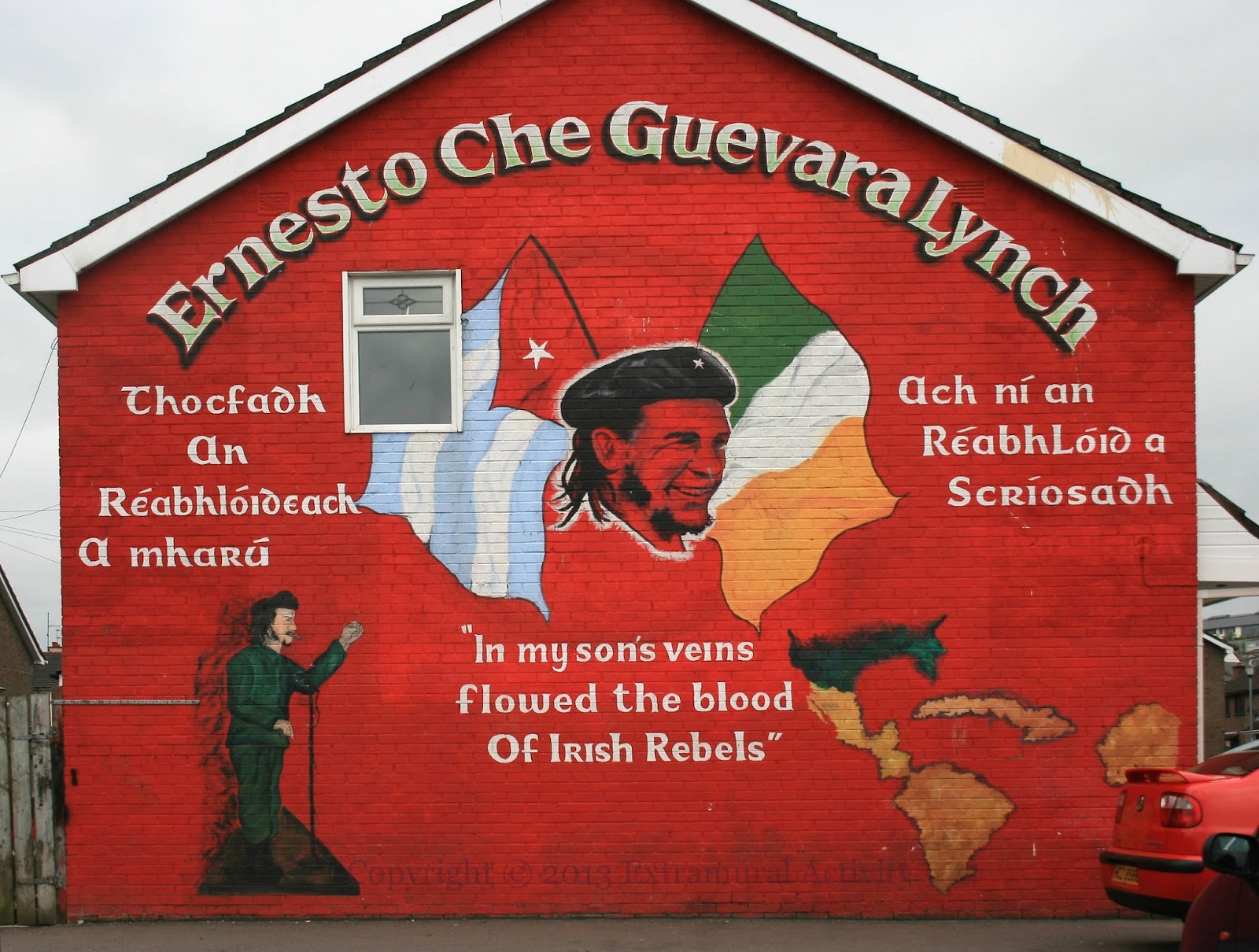
You remember them – those young Welsh lads born just too young to join the International Brigades or to take arms with Ernesto "Che" Guevara Lynch in pursuit of the international liberation of the
Che: 'In my son's veins flowed the
blood of Irish rebels'
working classes – so they formed a preachy pop band, instead. (Great tune, though.)
And much of the cry for an anti-Israel protest during the match is similar in nature.
We'll just fly some flags, take the fine – the club has plenty of money – and declare ourselves sedentary liberators of the Palestinian people and the international working class.
And if you don't – well, then take a good look at yourselves. You obviously don't care about the Palestinian children who could have been saved by that protest.
Who are these people and what to they actually DO to make a difference, (in the event that you don't consider Tweets and Facebook postings to be actually “doing” anything of substance)?
What sacrifices do they make, I wonder, in defence of Palestinians, in their daily lives. Boycott Israeli goods? Probably – that involves laying off the Soda Stream, eliminating 1% of your available wine list and being careful to avoid kosher salt.
How many of these people, for example, protest outside the Israeli embassy or risk arrest and incurring criminal records and fines? I have no doubt that there are a few – but, as for the rest, do they only notice what is happening to the Palestinians when Celtic are playing a team from Israel?
They insist that it will “only be a fine” but that's not clear at all. Do they want Celtic to play European matches with a stand closed – to make a statement? Perhaps they can dedicate that empty stand to Nir Bitton, so that he can watch the game in an atmosphere of acceptable solitude.
And, no, being Israeli or Jewish is not he same as being a Zionist but we do well when we remember to recognise the sensitivities of those closer to the issues that rightly inflame world opinion.
Why stop at the risk of a stand being closed? Surely the only morally defensible protest would be to refuse to play any Israeli club, risking expulsion from the tournament, as the club did under Bob Kelly when he took his stand against Warsaw Pact nations who had crushed the Prague Spring?
Why aren't they calling for that? Is it because Celtic being deprived of European football is too high a price to pay to save the Palestinians?
Where are the protests against Celtic's involvement in the International Champions Cup, given that it is an American tournament? The US is the greatest sponsor Israel has, without whose support, the IDF could not defend its country, never mind act with impunity in oppressing the Palestinians.
Why should we tolerate dealings with companies from the country that has done more to spread terror across the Middle-East and Latin America than any other?
Would it be too inconvenient to target American institutions? Would the costs to the club be “too high a price to pay”?
And who do these people think they are to dictate the exact nature that any protest must take?
Why can't they buy their tickets and refuse to take their seats, for example? They could have a public ceremony – away from the ground – burning their tickets, which would surely draw media attention.
They could raise funds for Gaza, take the opportunity to start a campaign to place pressure on UEFA and FIFA to expel the Israeli Football Association from its competitions, unless attacks on Palestinian players end.
There are a million causes and that of the Palestinians is one of those most deserving of support. That said, there are as many ways of supporting the people of that region as there are people there.
A pointless banner or flag-waving exercise that brings the club closer to the closure of a stand – depriving the team of support and fellow fans the opportunity to attend European games – will not achieve anything.
If someone can tell me or anyone else just why the above statement is wrong, please let them do so.
And before Wednesday – I'd quite like to watch the game.
--
There is something in the air around Celtic Park at the moment, for now little more than a faint aroma but it's growing.
Brendan Rodgers asked Celtic fans to trust the players after another night when questions were asked but the right answers were delivered.
Young Team: Eoghan O'Connell and Moussa Dembele
It was far from a perfect performance and there were a few players who illustrated why Brendan is still said to be pursuing four other signings – but more of them another time. This is a time to be positive.
He is right in everything he says about fans' impatience creating extra pressure and anxiety. That leads to players making mistakes and it is only natural that a manager should try to do everything to create an atmosphere that allows his team to perform at its best.
But that trust is already slowly starting to build. If Brendan doesn't realise that, he should have been around last year.
For the past two seasons, many of the same players who were on display last night screwed up almost every time they were faced with a major test.
Fans were becoming accustomed to it. But there are signs that improvement is already being made.
There is an increasing sense that the players understand what is expected of them – both in terms of their roles and commitment – in a way that had been missing.
That lends confidence to the fans and, if understandably nervous, most seem to be getting back that sense of belief in the team.
It will take time – and consistent professional performances – to fully restore that trust but the green shoots of hope are there.
Kieran Tierney, Eoghan O'Connell and Patrick Roberts continue to impress but honourable mention must also go to Saidy Janko who showed some of the ability that caused Manchester United fans to have such high hopes for him before he was thrust into a transitional defence at Celtic.
There are areas for improvement in his game, such as his decision making, but, crucially, he looked like a player who could develop with the sort of quality coaching most of us believe we now have at the club.
And I can't be the only one to have waited for Moussa Dembele to take that penalty, thinking that we were about to witness a pivotal moment in his career.
My mind went back to the story of a 20-year-old Kenny Dalglish tying his lace before scoring a penalty against Rangers for his first competitive goal.
Kenny later admitted that it wasn't because he was cool-as-a-cucumber but instead he was taking the chance to steady his nerves.
We don't know how far Dembele will progress but we do not need to doubt his nerve on the big occasion ever again.
Kolo Toure also brought a sense of assurance to all around him although, ironically, the goal was conceded a few minutes after he went on. We seem to have a new top-drawer defensive coach but, this time, he's on the pitch – and he can play a bit as well.
But, for me, the most surprising change was in Scott Brown. I have long been an admirer and
Play it Kolo: Toure calls for calm
defender of Brown, often taking pelters for my troubles.
I was even once harangued for having mentioned him in the same article as Steven Gerrard and Frank Lampard although no direct comparison was ever made.
So I was amused to read Brendan comparing Scott to Gerrard in terms of leadership and commitment to the club.
Before he took a single match, Brendan replied, “150% yes”, to questions about whether the club captain would remain. When you hear the manager then praising him for tactical understanding and playing ability that even he hadn't expected him to have, you can finally put the constant critics to bed.
Last night's was a different performance from Scott, apparently free from being the sole input of drive in the team, trying to force play with sheer energy.
He seemed to have more time on the ball than on any occasion I can imagine, no doubt helped by the improved organisation Brendan Rodgers has brought to the team.
With that, came probably his best night in terms of ball distribution that I have ever seen from him – both long and short passing with both feet, including one 35-yard pass to put Leigh Griffiths through on goal.
Brendan has said Scott can be the playmaker and – pelters at the ready, now – there were even shades of Paul McStay in his readiness to take pressure off his teammates, switch play and create opportunities.
None of this need be taken as premature predictions of greatness for the team or individual players.
What we have are signs of progress and with them, early seeds of trust. It will be continued progress that will allow that trust to grow.
And then the sky's the limit. We may even start talking about hope.
--
For the past week, I have, I think been suitably gracious in my praise of Kazakh champions Astana, ahead of and after the first leg of our Champions League qualifier.
There are good reasons for that. Firstly, they are a good team as their home results against top-class European opposition have shown.
Secondly, the caricaturing of Kazakh people by Britain's best-loved racist comedian since Bernard Manning, Sasha Baron Cohen, with his Borat character has heaped humiliation on that nation in a way that has disadvantaged the country and, especially its young people.
Related to this is a sneaking suspicion that journalists in the tabloids that I do not read would not hesitate to big up those racist epithets with all the grace and dignity of an infant shouting, “funny wee man” at someone with an apparent physical handicap.
Kazakhstan is a nation asserting its confidence and its football teams are instruments of that.
Unfortunately, the country is also one of the most corrupt in the world.
Transparency International rates the country as coming 123rd (out of 167 listed states) in terms of above-board dealing. In other words, Kazakhstan hovers around the top 25% of the world's most corrupt countries.
Why is this relevant now? Because, when the referee was adding five minutes of injury time to a match that Astana had to win, that didn't seem to fit with the pattern of play during the match – but it would have seemed churlish to pick up on it at the time.
But when Astana are publicly issuing footage of Leigh Griffith wrestling off the attentions of Astana defender, Igor Shitov, – and claiming the clips showed a punch and red-card offence, you can tell that something from the darker side of football is afoot.
The referee on the night, allowed Patrick Roberts to be hacked down almost every time he made contact with the ball. Kieran Tierney was the subject of a ridiculous claim of a foul worthy of a face-holding.
These incidents are not coincidental. Astana identified Celtic's key players before the match and sought to neutralise them for the second leg.
In the case of Griffiths, he received a yellow card for the shoving in the box and therefore it should be impossible for UEFA to review the “incident” as if it had been missed.
But we now know the nature of Astana and, in terms of goodwill, at least, the gloves should be off.
That is to say that they will come to Celtic Park next week, where their players, staff and fans will enjoy a safe environment in arguably the best football arena in Europe.
But the underhand efforts of the club and its coaching staff should be seen for what they are – a bid to rob Celtic of our best players.
60,000 fans at Celtic Park? I wonder how the Astana players will enjoy their evening.
--
Well, it wasn't an emphatic performance but there are reasons to be cheerful tonight after Celtic left Astana with an invaluable draw.
The last two pieces on this blog both referred to the tie with Astana and for good reason.
“Glamour friendlies” are all very well but you only had to see the half-full Celtic Park on Saturday to play the English Champions in the International Champions Cup to get an idea of the difference between real competition and exhibition football.
Managers can say what they like about playing to win in these tournaments but the smiles all round after Leicester City won the penalty shoot-out showed that only the established UEFA-recognised tournaments count in football.
So, the complaints about Brendan Rodgers being left hamstrung were well justified – it is shocking that the club had to go into such a crucial qualifier without a recognised reliable central defender.
However, amid that sort of adversity, sometimes a genuine talent emerges who would not otherwise have been given a chance. In Astana, that was Eoghan O’Connell, rightly praised for a composed performance belying his young years and inexperience.
If we could just get a mirror image of the left side of our defence and apply it to the right, we would have lot fewer nervous Celtic fans.
The other post was on how fantastic a result a draw would be against a team that Galatasaray, Benfica and Atletico Madrid all failed to beat in Kazakhstan, last season.
So, in the circumstances, Brendan Rodgers and the players deserve all the credit coming their way for achieving that at such an early stage of the season, with such frailties in the squad.
There were mistakes and nerve-wracking times – far too many – but what was most encouraging was how Celtic managed to get a grip on the match in the last 20 minutes, when previous sides would have crumbled.
In fact, it was as if the team matured before our eyes, using the ball intelligently after Patrick Roberts and Leigh Griffiths had combined to produce a goal of exceptional quality.
We've had to many European disappointments to count in recent years, so there was never a sense of the job being done until the referee's final gift to Astana of five minutes added time had expired.
But, under immense pressure, there was a self-assuredness on the ball in the late stages that surely reflected the first meaningful improvement under Brendan Rodgers and his team.
There is still a major amount of work to do against an Astana side that showed once again that the generously funded Kazakh football has arrived and will make an impact soon.
We can look forward to that day – but hopefully not for another year yet.
Celtic supporters shouldn't underestimate the task awaiting their team in Astana
Happily, few Celtic fans who know the least about football now expect games against teams from unfashionable football nations, like Kazakhstan, to be a formality.
While the tabloid press will make crude caricatures about Borat and, no doubt, revel in describing the entire country as a backwater, a reality check awaits anyone who underestimates Astana.
Going through: Astana against Zalgiris in the last round
The signing of Kolo Toure is impressive given the fact that, despite being 35 years old, he was playing in the Europa League final for Liverpool, just over two months ago.
He will surely help the others in our most under-staffed position. However, Toure's arrival comes too late for the first leg and there must be question marks over whether he will be ready next week.
It must worry Brendan Rodgers that he appears to have to choose between starting 20-year-old Eoghan O'Connell in Astana or even playing a back three in a vital European qualifier.
Up front, meanwhile, Leigh Griffiths looks to be in good form already, Moussa Dembélé looks as if a little extra sharpness in front of goal will see him start scoring soon and Nadir Çiftçi probably won't.
So much for Celtic's much-discussed weaknesses. More pertinent is that Astana qualified for the Champions League last season, remaining unbeaten at home, with draws against finalists Atletico Madrid, Benfica and Galatasaray.
In fact, they went through the entire competition (including qualifiers), last season, without losing a home match and took the scalp of Maribor along the way. Domestically and in European competition, they have lost just one match since the beginning of March and top their domestic league by seven points with a game in hand over their nearest rivals.
All that adds up to a major challenge, even without their captain Tanat Nusserbayev and suggests in the circumstances that anything better than a 0-0 draw would be an exceptional result.
It is likely to set the pulses racing, more in terms of tension than in attacking football, though Brendan will presumably expect his players to keep pressing and playing to a high intensity.
But on this occasion a boring match with no goals would set up a Celtic Park return where, hopefully, the crowd could carry the team to victory.
For once, it was starting to look so rosy. Just a few weeks ago, 13,000 fans turned out to greet Brendan Rodgers, unusually, in recent times, an acquisition that somebody else wanted.
He gave a model performance as he was unveiled to the fans, sounding like a Celtic man who actually knew quite a bit about football.
Great!
The season ticket money started to roll in, we settled down to watch Euro 2016, confident that the club had learned lessons from its dealings in the past and we would start to see real improvement - we even signed a promising striker!
Moussa Dembélé is the right age, showed good form last season and is on the way up.
And then...
Not much.
Anyone who saw the two legs against Red Imps in the Champions League qualifier could be forgiven for thinking that Ronny Deila was still in charge of Celtic.
That is not intended as any reflection on Brendan Rodgers: he has only had two competitive games. But, this time last year, we were talking about déjà vu from the season before.
Now, the feeling is very similar.
Yes we had a lot of possession against the champions of Gibraltar but the 3-1 aggregate and performances over the two legs told us something: that we don't have nearly enough good players.
It's hard to say if they are talentless as whatever skills several may possess have been concealed under a veil of gutlessness.
Of those who were with Celtic last year, only Griffiths, Tierney, McGregor, Sviatchenko and Roberts have looked up to the mark in the early games, this season.
And Roberts - the most talented footballer at the club - isn't even our player.
Dembélé and Ajer look to be good signings but the rest require either rapid improvement or economy class plane tickets.
We could each pick our favourite targets but James Forrest epitomises everything that has been wrong with Celtic for at least two years.
We know he can play because we’ve seen him. The trouble is that he rarely does. If a winger who was touted as a £10m player three years ago can't make something happen against a part-time team, it's time for Forrest to run - anywhere you want but just not in a Celtic jersey.
He is one of many culprits.
But Celtic go to Kazakhstan to play Astana in a few days time and, on recent form - without having shored up glaring weaknesses - must be second favourites.
We retain hope and will try to summon some confidence before before Wednesday but the sad reality is that few of us believe we will be comfortable winners.
If we do, we can look forward. If not, we'll know who to blame.
The same people as last time - and it's not Ronny Deila.
--
Imps 1 - 0 Limps: Lincoln was Celtic's worst ever defeat
It is only a few weeks since 13,000 fans turned out to welcome the new Brendan Rodgers era.
And Rodgers still remains a top appointment.
But, like Gordon Strachan found with Artmedia Bratislava and, before him, Liam Brady discovered against Neuchâtel Xamax , away games against weaker teams can provide the stage for a humiliation.
Defeat by Lincoln Red Imps is, by some way, the worst defeat in Celtic's history.
Credit to the Imps – they played a solid, professional game and, sadly, deserved their victory.
But a 3-0 victory over the champions of Gibraltar would not have been hailed as impressive.
Most will expect the return leg at Celtic Park to be too much for the Imps and a better surface in front of a big home crowd should be enough to allow Celtic to squeeze through.
Then again, people thought the same for the two matches mentioned above – and Celtic fell short both times.
No, there is no need for panic but the spotlight has been turned on previous seasons' transfer activity again.
Indefensible: Efe Ambrose
Firstly, any coach should have a clause in his contract defining playing Efe Ambrose as a dereliction of duty. Ambrose excels a back-flips but that appears to be his only athletic ability.
He continually plays matches as if he's trying to remember if he turned the gas off before he left the house and whether or not he needs to stop off at the 24-Hour Tesco for milk before he gets home.
With that level of concentration, his lack of positional play, inability to anticipate, crude tackling, poor timing and chaotic passing seem unlikely to offer any hope of him ever developing into a defender.
There are others but let's not turn this into a “names of shame” exercise.
However, collectively, Celtic still lack energy, ideas or any demonstrable fighting spirit.
There is undoubtedly talent within the club but evidently not enough of it.
There may be no need for panic but what we have seen on the field has not given any cause for optimism.
And if the professionals at the club don't show far more focus in the return leg, this will be a season of “glamour friendlies” instead of European competition.
--
Share
Wade through the euphemisms, the obscure language and the evasive waffle and Celtic's interim accounts, published yesterday, represent a total failure of the heralded strategy at Celtic Park.
So catastrophic has this been that, in any other company, the Chief Executive and chairman of the Board of Directors would be looking for new jobs.
Let's get one thing straight. Celtic chose not to invest adequately in the team during season 2008-10. Their rationale was this – that it would be in the club's financial interests to be “prudent”, to reduce debt and favour “banked cash”. Those of us who pointed to the fact that failure to invest in strengthening a defective squad would lead to us losing out on future revenues were decried as reckless or naïve.
The prevailing wisdom as espoused by that new breed inhabiting an increasingly notorious supporters' blog (it may be noted that an “independent” fan's site was able to publish the figures even before the official club website) was that this policy equated to wise stewardship of the club and it's much-vaunted pursuit of “zero debt”.
Well, while the accountants, the politicians, the spin merchants and their allies have been carrying on their programme of obfuscation, let's address some simple facts:
Debt increased from £0.97m to £3.13m
Turnover decreased by 22.8% to £36.11m
Perhaps it is time for someone at Celtic with the integrity, honesty or “moral courage” to confess that some of those fans who were so long taken for granted as fools, easily parted from their money, were right.
Celtic lost out on approximately £2m that would have been earned from the Peace Cup alone – due to the club's failure to win the SPL and automatic Champions League participation.
Celtic lost out on somewhere between £5m and £8 from Champions League participation.
The club also missed out on prize money that should have been attainable from the Scottish Cup and SPL title.
Now, while we await the accountants producing their boxes of tricks to tell us that around £10m in prize money and participation fees would not have wiped out £3.13m debts and left £6.87m over for player investment, let's look at the other elephant in the room.
Celtic plc – Dermond, Reid, Lawwell, Riley et al – calculated that they could pursue this policy and still expect Celtic fans to fund an approach that had abandoned the principles of competition, never mind the sporting traditions of Celtic. They were catastrophically wrong as attendances have shown.
They can point to the success of the away kit (conveniently overlooking the “international kit” that is unlikely to be needed any time soon) but more pertinent is the fact that increasingly the direction of Celtic resembles the flight of the bumblebee.
We are asked to believe that it is the “sustainable economic and business model” and financial stability” that “has delivered the continuing support of our kit manufacturer, Nike”.
And to think some of us thought that Nike invested in high-profile clubs with positive brand associations. We now know that they do not value a worldwide fan base and successful participation on the European stage but are instead keen to invest in businesses with the least radical accounting practices.
When the lies, selectively presented facts and evasion have passed. What will be left of Celtic?
Well, here we go again – Celtic go away from home in the Champions League and agai….
Let’s stop there.
We really don’t need a constant update on our incredible lack of success in Europe’s top tournament away from home any more than we require a forensic analysis of why only great Spanish teams beat us at home.
As far as the home record is concerned, give the press their moment – it’s all about the “atmosphere”. Jungle veterans might question whether or not the intimidation factor of high stands of seated fans is a more frightening prospect than the swarming, roaring terracing that faced innumerable sides but Gordon Strachan might shed light on the issue from his time as a Don.
But what happens away? It’s a mystery… No, that’s bovine excrement.
The explanation for Celtic’s contrasting home and away records is simple to the mind of this humble blogger. European football is, in many ways, profoundly conventional. It follows orders, natural or otherwise.
When teams come to Celtic Park, (with the exception of the very best) they tend to play like away sides are supposed to in European competition – they allow the home team space and time on the ball in supposedly non-crucial areas, hoping to smother attacks and construct carefully considered counters.
Result? The skill and relentless forward pressure as demanded by 60,000 fans has repeatedly seen Celtic secure great results.
Away from home it is different. No decent team cedes the initiative on its own patch and the result is matches of radically different character. Playing any half-decent side, Celtic players find themselves with far less time to control the ball and make a pass and far less options as outlets – i.e. team-mates who are in space and not under pressure.
The outcome tends to be panic and loose balls or rushed passes played too hard to the feet of closely-marked players. This was the story on Tuesday night at El Madrigal – but there were signs of hope.
When Gordon Strachan mentioned the positives in Celtic’s display most paid pundits gave him short shrift. The reality is, however, that this was one of Celtic’s best away performances for years – against an exceptionally gifted team – but one that merely emphasised the historic gulf between the finest team in the Scottish league and a noble club battling for recognition in Spain.
Celtic showed that we have an attacking forward unit that is edging closer to the standard required. Georgios Samaras did everything but score the goal –evidence that a gifted player with too low a pulse rate can fluff chances as crudely as a panicking adrenaline junky.
Pundits differ as to the performances of the midfield but, to this observer, Scott Brown was Celtic’s best player on the night and one of the very best on show. Close behind him was Shunsuke Nakamura, popularly maligned in the press, giving evidence that even good Celtic footballers such as Craig Burley can lose all appreciation of the game when watching from the stands.
It is now the received wisdom that Nakmura was “ineffectual” and in all humility, I am prepared to accept that I know less about the game than the legends of the Scottish football press. However, I saw a player being asked to perform in a different, less headline-grabbing role; who would be the link man for every panicked release or pass of uncertain ideas, in doing so compensating for the lack of a second striker.
Those who criticised Nakamura can hardly have noted the number of times too-hard passes were played directly at his feet, only for him to control the ball and re-emphasise play in another area within a second.
This was one of the few occasions when Celtic have tried to play the fast passing game that comes so naturally to teams from the better leagues. For a short period, the players managed it but the weaker links remain – some in unexpected areas.
First, to the full-backs. Lee Naylor has endured much criticism and that need not be expanded upon here. However, defensive deficiencies are enough to contend with: recklessly swung “crosses” under no opposition pressure are an uncalled-for extravagance.
On the right, Mark Wilson had another night to forget – make that a night to file under “Ipcress File” and hope never to recognise mention of it again. There is an unwelcome sense around Wilson that he will be perennially injured and never fulfil his potential. Certainly, he can play but last night’s performance is perhaps best put down to fitness issues keeping him off the pace throughout the match and making him look utterly out of place in the “zonal marking” defence.
Wilson is a good right-back and a very unlucky one. How long can he exclude a German international and a surging young talent such as Paul Caddis?
Artur Boruc, Stephen McManus and especially Gary Caldwell (who we should not praise in case he loses it again) were all on top form and the midfield unit, with Paul Hartley as its safety valve, worked quite well.
However, this was a night for mixing it with the big boys and that was where Celtic’s precocious talents were found wanting. In the first half, Aiden McGeady was his frustrating worst – never knowing when to take his man on or turn and pass; almost invariably getting it wrong. At the same time, Shaun Maloney was energetic and well-positioned but seemed incapable of playing the ball in front of Nakamura, actually advancing the ball, instead blasting it at his team-mates’ feet.
After the interval, the roles were reversed. McGeady was the boy most likely to succeed while Maloney was rarely noticed.
Unfortunately, these deficiencies were demonstrated at the ground of a first-class football team and one with which Celtic should be proud to be associated. Villareal had only good and very good players on show. If Marcos Senna was the best player on the field, however relentlessly harried by Scott Brown, Santi Cazorla will have equally whetted the appetites of scouts or even those nostalgically checking in on Robert Pires.
Celtic were second-best, alright – but maybe to the best team in the group.