Showing posts with label neil lennon. Show all posts

Saturday, December 05, 2020

Desmond and Lawwell: the unacceptable faces of Celtic

Lawwell briefed every friendly hack, ex-Celtic employee and blogging shill that the supporters could stick their views where the sun don't shine

I freely admit that I've had mixed feelings about the Green Brigade.

They have undoubtedly improved the atmosphere at Celtic Park – most of the time – their displays are often magnificent and I generally share most of their politics.
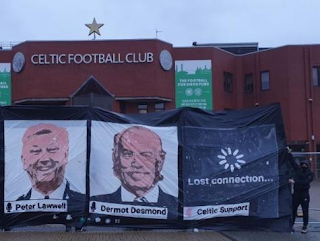
Banner with Lawwel and Desmond's faces

On the other hand, I sometimes feel that they believe themselves to be the self-appointed heart and conscience of Celtic; they can be too eager to be seen as European-style “ultras” (with that “style” perhaps more important than substance) and their displays sometimes miss the mark, occasionally to the club's overall detriment.

I was not in favour of their “Time to go, Neil” demonstration at Celtic Park last Wednesday. Not because I disagreed with the message but because it seemed like just the sort of action that, not so long ago, ultras of another local club would have pulled to the great amusement of Celtic supporters, as another episode of the “banter years”.

But, as a fan who has had almost no faith in the powers-that-be at Celtic for well in excess of a decade, even I had failed to anticipate the extent and brazenness of the contempt that the Celtic suits were prepared to direct towards the supporters. 

Thousands of supporters had paid hundreds of pounds for season tickets for matches that there was never any real prospect of attending because they wanted to support the club through extraordinary times and help secure the ten-in-a-row record that matters to those of us who care about football. 

Many more had spent eye-watering sums on Adidas kit – which is lovely – but, unless donned by players performing to the standards that should be expected of a Celtic team, is nothing better than lipstick on a pig.

I, for one, was not in the least surprised by the capitulation to Ross County last weekend. Admittedly, I had been taken aback by some of the worst European performances in my lifetime, suffering back-to-back 4-1 defeats by a Sparta Prague side that is, frankly, not a good team.

But as a veteran of the now-infamous 1990s, I know a team that has the Indian Sign over it and this Celtic side definitely qualifies. When a team is in this type of form, naïve fans hope that one good performance will turn it around while others know it usually goes from bad to worse.

So, I had every sympathy with those Celtic fans who got off their backsides and told the Directors, coaches and players what they thought of the whimpering defeat by Ross County.

Were there some regrettable moments? Yes – but spontaneous displays of anger are, by their nature, difficult to control and the essence of the demo was to confront the many impostors currently benefiting from the cash eternally pumped in by the fans with the feelings of the majority of fans.

In response, Lawwell briefed every friendly hack, ex-Celtic employee and blogging shill that the supporters could stick their views where the sun don't shine.

So, my views of the latest Green Brigade banner are more supportive. I have chosen to crop out the image of Neil Lennon because he does still deserve some consideration for his overall contribution to Celtic.

However, he assuredly does not deserve to be Celtic manager. 

Neil can remind us of all he has done over twenty years and he is right. He has, in the past, endured obscene abuse for being a Celtic captain and manager who had the temerity to be an “uppity Tim” in a country that is still nowhere near as welcoming to some communities as many of its citizens would like to believe.

But that doesn't mean that he has the credentials to lead a club that its fans would still like to believe should be a major player on the European scene.

Let's make no mistake – this isn't about the ending of any possibility of a “quintuple treble” – and the quadruple is no formality. (If Ross County was Lennon's Caley Thistle, Hearts could easily prove to be his Raith Rovers.)

This is about an ever-more power-crazed Chief Executive, so determined to control every facet of the club that he has now sabotaged the dressing room. Anyone who has ever worked for one of those managers who prefers to sow division in their own department – making each appointee beholden to them personally – will understand how toxic and fatal to aspirations of success that is.

Lennon is a problem because he is not up to the job; though his reluctance to give up his last big opportunity in football is somewhat understandable.

Peter Lawwell is a problem because he increasingly appears to be a narcissistic megalomaniac, who would cheerfully watch Celtic disintegrate as long as his bonus was paid and no one challenged his monumental ego.

And above the two of them, Dermot Desmond is a problem because he doesn't give a dam about football, never mind Celtic, but sees the club as a means to getting even more money through getting Celtic into another league and turning his investment from lead into gold.

Much is unacceptable about Celtic now – the performances, the professionalism, the attitude of some players, the coaching set-up and the manager.

If there is another demo at Celtic Park on Sunday, the main targets will be Peter Lawwell and Dermot Desmond – the real unacceptable faces of Celtic Football Club.--

Sunday, March 03, 2019

Who will be the next Celtic manager? The tan and teeth guide to following Brendan Rodgers

It's that time again - and it will probably last for three months.

It's the time when every loon, attention-seeker and "in the know" tosser gives their tuppenceworth on who should be the next permanent manager of Celtic.

Many of the would say that I know little to nothing about football. But I would counter that that makes me as qualified as the most successful football pundits in Scotland, so why not share my wisdom?

(Rather depressingly, many of the names below have been literally copied and pasted from a previous article on this site, at the end of the Ronny Deila era.

So, here goes:

Neil Lennon
Like the vast majority of Celtic fans, I have admired Neil as a player and coach since he was first signed by Martin O'Neill.

That said, I was against his appointment first time round (due to his inexperience) and I wasn't convinced that he would be a huge success when he left us.

But his time with Hibs seemed to demonstrate that he had far greater tactical knowledge than I had given him credit for.

Perhaps being with Hibs, not Celtic, he was more likely to be questioned on what happened in games than pressed for a big headline or perhaps he has just developed but he seems to have shown that he can evolve as a coach, which is a vital quality.

He has also, of course, won three titles and experienced the best and worst that the job can bring.

My personal view: still tending against it but softening somewhat (more on that later.

John Kennedy
There have been rumours that Kennedy is highly regarded by both the players and the board. But is he ready for the big job right now? Probably not.

Marco Rose
One of the more intriguing suggestions. He has worked wonders with Red Bull Salzburg, who took maximum points from our Europa group.

Salzburg also work with a limited budget in a minor league, but with world-leading facilities.

It would be a huge coup but the Bundesliga surely awaits him very soon.

Roberto Martinez
Has been linked before and heavily touted as a candidate.

After a very successful World Cup with Belgium, his stock is high and would be a candidate for any number of top clubs.

Still, he has Shaun Maloney in his coaching staff.

Mark Hughes
The English football pundits' idea of a football manager.

That's why he should manage a team in the lower half of the Premier league or the Championship.

Doesn't know how to smile.

Steve Bruce
See the entry for Mark Hughes above.

Jack Ross
Doing a solid job with Sunderland having been Scotland's manager of the year, last season.

He certainly talks the talk but would be a huge gamble.

John Collins
Absolutely not. Collins has the air of a self-annointed aristocrat of football. Rumours of him rubbing people up the wrong way seem all too credible because he just exudes smugness.

Plus, we must be careful of making white teeth and a permatan a tradition in our managers.

David Moyes
Moyes might well do a good job but he has spent the years since leaving Everton, for the most part, making his own club's supporters cry. I don't think so.

Gordon Strachan
It seems that Gordon probably has no appetite for the intense pressure of the Celtic job again. So, that rules him out.

Martin O'Neill
No doubt he could deliver titles again and may even be tempted to leave the bright lights of Nottingham but it would be very much back to Martin's way, which is not going to progress the club.

Plus, he would bring Roy Keane.

Roy Keane
Let's hope not! The man punches people who ask for his autograph.

In his second autobiography (because one is never enough) he stated that going to Ipswich was a mistake because, having taken the job, he discovered that he couldn't motivate himself to put his heart into a team in blue.

He should be in a secure unit on an island somewhere.

Mick McCarthy
Good old mick. I have a soft spot for him and he gives the impression that he would nut a lamppost if it caught him on a bad day.

I'm not sure that's what the coaching blend needs right now.

Henrik Larsson
Not this again! We all love him and respect him utterly. Let's keep it that way.

Alan Stubbs
He'll reckon he could do the job but recent evidence is that he's a far better pundit than a manager.

Steven Gerrard
On the plus side, he both knows Rodgers's methods and has experience of breaking his heart.

Negatives (too numerous to list) include the fact that he thinks £1m is an eight-figure sum.

Derek McInnes
When hell freezes over.

Michael O'Neill
No doubt his name will crop up again and I wouldn't put it past the board. He's good at what he does with meagre resources but it would be suffocating football.

Malky Mackay
A name only suggested by a mainstream media pundit to stir things up. He would be a PR disaster and has a reputation for liking to spend on players.
But you can bank on his CV already being in.
No.

Steve Clarke
A popular choice who has apparently said that he doesn't want another job in Scotland.

Probably would be very successful and has excellent credentials.

Steve McLaren
Just the sort of tosser Celtic plc would like to foist on us, accompanied by a puff piece on a well-known blog, telling us how smart a move it is.

Paul Lambert
That guy who will always believe that he is a much better manager than he is. He should be managing Aberdeen or a club of similar stature.

Owen Coyle
Would bring all that Bolton and Raith Rovers experience - and appoint someone like Lambert as part of his "dream team".

Jose Mourinho
Made a comment about Rodgers having left at the wrong time and started an Internet rumour in the process. It's one of the more fun rumours but a non-starter.

Arsene Wenger
Let's stick with the silliness. He can certainly coach players, has big-time experience and might even see Celtic as a stepping stone to Leicester some day.

In reality, he'd probably prefer to manage a French or maybe Belgian club and there would be no shortage of offers.

China or the MLS would also be more likely than Celtic.

So, that's just a few of the people who probably have no chance of being the next permanent Celtic manager.

But, going back to Neil, there is a possible scenario in which his appointment works.

I hope for a management team that can retain the best elements of the Rodgers reign but with greater tactical flexibility, the ability to compete in Europe while entertaining without being kicked off the park.

Having worked with Rodgers for two-and-a-half years, John Kennedy will have retained the knowledge of the good things he did - top-level training/coaching, analysis, etc.

But Neil is probably better tactically, equally good at motivating players and has the experience of being in the firing line but delivering a winning team.

So, maybe the Lennon-Kennedy partnership could work for, say two years, with a view to readying John for the big job.

Shaun Maloney might also be enticed to join, bringing his experience of working with Roberto Martinez.

Why not develop a high-tech "boot room" combining all the elements that a modern club - but identifiably Celtic - needs?

If Neil were to agree to step aside in May 2021, the next man to join the group could be Scott Brown, with the hope of three-to-five successful years under Kennedy to prepare him for the job.

The downsides could be that it would look like "all Lawwell's men" and that these plans are never guaranteed to succeed.

However, I'm convinced that we need the above elements and we are unlikely to recruit someone who brings all of them.

So, to quote a famous advert, "It's a long shot but it might just work."

Thursday, July 05, 2018

Celtic in for John McGinn? If you know the history, the move would make sense

Anyone who reads this irregularly-published blog more than twice a year can tell you that I never shy away from saying, "I told you so".

I make no apology for doing so as I simply have a near-perfect memory for those occasions on which I have been proved right.

A cynic might suggest that's because they are so few in number but that's not true.

In fact, they are too many to count on the free fingers of my hands while I type this.

One of those times was my enthusiastic support for Scott Brown, from the outset. Scott's critics are a lot quieter these days but I still have their names in a sealed envelope in my desk.

But the memories some hold of the days when Scott signed (for ten times the price of Kenny Dalglish) seem to have dimmed.

It went like this. Neil Lennon, the most-targeted player in Scotland - by opponents, fans and media alike - was coming to the end of his historic captaincy of Celtic and Gordon Strachan was openly musing that he would leave a gap that would be extremely difficult to fill and perhaps impossible for one man to replace.

What Gordon meant was that he wanted the talented, battling young engine-room of Hibs - Scott and Kevin Thomson - to provide the foundation for the future of Celtic.

We now know that Celtic's Peter Lawwell allowed himself to be beaten to the punch by Walter Smith, seeing Thomson head off to Ibrox, by his own admission, taking the first offer to get away from John Collins.

Many - not least Derek Johnstone - expected Scott to follow his close pal and team-mate but the player had other ideas. Massimo Donatti - a good servant to Celtic - was recruited by Celtic's clever scouting operation deeming him a player who could do what Thomson did.

Apparently, this cleverness had omitted to account for the impact on both players and Celtic's ability to replace Neil with what might have been to Celtic and Scotland a midfield partnership to be spoken of with the same relish as the centre-backs, Miller-and-McLeish, was to Aberdeen and Scotland fans in the 1980s and 90s.

Personally, I had always quietly admired Thomson, though I much preferred Scott. (I recall an English friend spluttering that Thomson must be a player if I was complimenting a guy who had played for Rangers.)

While I may have digressed, Celtic are coming to another watershed moment, though planning for it with rather more foresight than when Scott was thrust into one of the most unforgiving positions Scottish football could offer and basically told: "Perform!"

Referees and a minuscule sense of fair play permitting, Scott's legs have a few seasons left to run but the void that he will leave will be no smaller than when Neil hung  up his boots for Celtic.

He is Celtic's captain, unquestioned leader, icon and, in this blogger's opinion, still our best player.

So, we do need to plan for that sad day when Scott finally takes his last bow for Celtic.

And it would be utter folly to try to find a replacement at the time. A comparable player would be far beyond the means of Celtic and, even then, by no means guaranteed to make that step  successfully, never mind immediately.

So, we absolutely must plan for a slow transition. And that's where John McGinn comes in.

Forget false comparisons between McGinn and Stuart Armstrong, which many have made. Armstrong has all the technical tools to be a top footballer but had never shown the stomach to be a Celtic captain or midfielder ready to take responsibility for all the good and bad that may happen to the club.

And, aside from that fact, they are players of very different styles.

The more direct comparison with Armstrong would be the vastly-superior Olivier Ntcham, who is a footballer of the highest quality. So much so that I believe that next summer's clamour will be for the signature of Olivier.

To turn a metaphor on its head, Olivier could be described as a velvet fist in an iron glove. He has such a good touch with both feet, as well as superb balance and reading of the game, yet his powerful physique enables him to show these skills when under intense physical pressure.

He shares many of these attributes with Moussa Dembele and these are highly-prized at the top levels of the modern international game.

So, appreciate Olivier while he is here, as I expect Europe's top clubs to be using a battering-ram on Celtic's front door, rather than knocking.

That leaves Eboue Kouassi, for whom I still retain hope. Eboue has made two massive cultural changes in just a few years, going to Russian and then to Scotland before he was twenty.

So, it shouldn't be a great surprise that he hasn't made a major impact in a year-and-a-half.

Eboue is another obvious contender to assume the mantle of Scott but, as with Neil Lennon, replacing our captain may be too big a job for one man (even, if for some different reasons).

So, we come to Hibernians' John McGinn.

Is he as good as Scott? Let me join in with those wailing, "No!", as if any player in Scotland could be, with Scott having swept all awards last season.

Could McGinn be as good as Scott? With similar dedication and excellent coaching, I think it's possible.

I do think that Scott had a bit more than McGinn when he came to Celtic. Then again, I had rarely seen a player with that unstoppable dynamism that Scott possessed, coupled with his instinct to create an attack when, in those days, he invariably rose first from a crumple of bodies and immediately looked to play the ball forward.

But I do see huge potential in McGinn and, given great coaching and top-level experience, I think that he has what it takes to develop into a future Celtic captain.

It's easy to forget that the coaching of Gordon Strachan and Brendan Rodgers, in particular, coupled with Scott's own maturing and intelligence have combined to produce a player who I wouldn't swap for anyone else in the world.

The criticism of McGinn saddens me, not least because of its merciless negativity.

As the great Tommy Burns once said, you should always focus on what a player CAN do for you, instead of what they can't.

John McGinn - the best player in Scotland last season, outside Celtic - can already do plenty of things in midfield.

Learning from Scott and coached by Brendan, I would like to see what else his game has to offer in green  and white.

The Hooped kind, of course.
--

Tuesday, February 27, 2018

Brendan Rodgers rightly backs Neil Lennon, who is both right and wrong – Confused? You will be...

For those outside Scottish football, the attacks that Neil Lennon endured have been so unfathomable as to make it pointless to try to explain.

I once tried to illustrate this to an English fan – not just the sectarian abuse that, in my experience, usually leads fans south of the border to mutter about everyone being “as bad as each other” – but about the death threats, the real bombs sent to him, the Hearts eejit who assaulted him, admitted it and still got off the hook, despite having sent a letter of apology.

I say this because I do not believe that Neil brought any of this on himself and I would like to address that before going on to comment on his behaviour at the weekend.

As with any top football manager, Neil is in a high-pressure job in which the competence or otherwise of decision-making – entirely outwith your control – can be the difference between winning trophies or losing your job.

So, it’s difficult to criticise Neil when he is exasperated with the standard of refereeing in Scotland, which would disgrace any professional league or association.

He was incensed at referee Kevin Clancy’s decision to award a penalty against Ryan Porteous and sometimes it’s refreshing to hear a manager call a spade a spade – or, thanks to Google Translate, a Scottish referee an amateur.

When Neil let’s rip, he really doesn’t hold back. Speaking about Clancy and Scottish refereeing in general, he said:

“It's hit Ryan here [on the chest]. The ball is going a mile wide as well. We've seen it again and he can't see it from the angle he's at. This is the same referee who didn't given us a clear handball against Rangers at Easter Road.

“As for me being sent off without really being over-critical of the decision at the time, he's made it personal because I criticised him after the Easter Road game. I am not happy with him at all.

“To send me off, I'm far from happy. And then I can't do my job for the last half hour. Why can't we send referees off when they are so blatantly ruining the game?

“I don't want him refereeing us again this season. But I probably won't get my way on that.

“Huge decisions have gone against us this season. I'm at my wit's end with referees at the minute. You ring John Fleming on a Monday and you get the same ‘Yeah, yeah...’,”

“You go round in circles and I've lost a lot of faith in it, to tell you the truth. That's why I've not really got on the wrong side of the law this season. It's amateur. Mickey Mouse stuff.”

Most of Neil’s comments will find a sympathetic audience with Hibs and Celtic fans. The best that can be said of Scottish refereeing is that it is abysmal. The worst is that it is corrupt and it would take a truly objective – or at least distanced – eye to try to discern between the two.

So, when Brendan Rodgers offers words of support, we can take it that he is not just backing his fellow Ulsterman but is similarly concerned by the standard of officiating.

As Brendan said: “I have seen a lot of strange decisions. The guys are doing the very best they can, but some of it I can totally understand where Neil would come from.

“It was something that is in the heat of the moment. He has obviously seen something clearly and for Neil it has probably been tagged on to one or two other incidents that has cost his team.”

Both Brendan and Neil are right about the decisions (which we are not allowed to attribute to bias in any form, lest we be decried as social media cranks by print and broadcast media cranks).

But, while many Celtic fans are jumping on Brendan’s comments as endorsing Neil’s criticism, the Celtic boss is, as ever far more measured.

Brendan has far too much nous, experience and training to go down the route of claiming bias and he would be unlikely to attach his name to such comments.

He may truly believe that the officials are “doing the best they can” (and most probably are) but making enemies of the same people who Neil chooses to go to war with is neither pragmatic nor Brendan’s style.

Neil Lennon has had few defenders during his time in Scotland and he will surely appreciate the most respected manager in the land extending public sympathy for his frustration with referees.

But that should not be interpreted as supporting everything Neil says.

The previous villain was Stuart Dougal, who did seem extremely ill-disposed towards him, and most Celtic fans took Neil’s side.

Is Clancy a bad referee – oh, yes! Does he have a festering grudge against Neil Lennon – probably not.

But while Celtic and Hibs fans back the warrior from our tribe, something else has been almost lost.

However, badly Kevin Clancy may have refereed, Neil Lennon’s aggression towards him should not be endorsed in any way.

This was not a player on the field reacting to a vicious challenge but a manager of a club with a great history, seething venom into the face of a match official.

Many will have enjoyed that, but this blogger did not.

Some people learn to nurture aggression as a “stay-away” defence. That can be because of internal fears or, for example, traumatic experiences.

But there should be a reasonable expectation that people can go about their professional business without facing physical intimidation.

Neil’s combative qualities largely served him and Celtic well on the football field, where there was never a shortage of hostile opponents more than willing to inflict pain and damage, given a hint of weakness.

But the role of manager requires more measured judgement and controlled behaviour than Neil demonstrated at the weekend.

Make your point, Neil. Fight your corner. Focus a spotlight on issues that demand debate.

But don’t do it nose-to-nose with a man who, however flawed, has never presented physical aggression to you and deserves to do his job in a safe atmosphere.

Otherwise, you will stand accused of trying to intimidate people in a manner that would not be tolerated in any normal working environment.

And you may find that the kind words of sympathisers like Brendan Rodgers become thinner on the ground.

Oh, and another thing – settle in at Hibernian. You will never be Celtic manager again.
--

Wednesday, April 20, 2016

Six good reasons why Neil Lennon should not be Celtic manager

Wanderer: "I wonder if I could get back to Celtic"
Neil Lennon is “open to a return to Celtic”. Let the bells ring out!

Now, I'm not going to forget the service Neil gave to Celtic as a player or as a manager.

On the other hand, anyone entertaining notions of bringing him back should allow themselves a reality check.

Neil got the Celtic job – his first in management – because he was prepared to take on a position in circumstances that other, better-qualified, candidates refused to consider.

It was a huge gamble. The last managerial rookies to be given the job had been Liam Brady and John Barnes – and look how those experiments worked out.

He did well – nobody could reasonably say otherwise – winning three titles and two Scottish Cups. And he delivered some memorable European nights, most notably that incredible win over Barcelona.

When he left, it was with the best wishes of most of the fans and he was quite within his rights to do so.

But, that doesn't mean he should be back – and there are several reasons why he should not be given the job.

Firstly, Neil left for good reasons. One of those was his wish to pursue higher aspirations; another was that the wheels were falling off the cart before he left.

Most of us could see that – a 6-1 humiliation at the hands of Barcelona being the worst kind of confirmation of that downward spiral Celtic were in.  I thought it was a smart move at the time, indicative of a club recruitment-and-sale policy that was leading us to on-field ruin.

I recall a Norwich fan joking with me that I must be crying in my beer, as he was expected to go there at the time. I replied that I was relaxed about his leaving. I thought he would do a good, professional job but not set the heather on fire.

That was more-or-less how things transpired at Bolton. He made a big initial impression and, admittedly under difficult circumstances, the endeavour turned out to be a damp squib.

So, reasons 1 & 2:

There is nothing to suggest that the conditions at the club are better than those that Neil left and there hasn't been a cavalry charge for his services, since he parted company with Bolton Wanderers.

When he was on the way up, Celtic wasn't big enough for him, But now it appears he thinks the job should shrink to fit inferior managers, who have tested themselves at Championship level and would like to make a big splash in a small pond again. Thanks, but no thanks.

Reason 3: As has been pointed out recently, Neil's record in his last two seasons was very comparable to Ronny Deila's – which was just not good enough, right? QED!

Reason 4: Some of Neil's conduct has not been exemplary and while we are all entitled to a private life and to our transgressions, I do not want to see the sort of news story – “blackmail” or not – that he endured at Bolton coming to Celtic Park.

Neil endured horrendous abuse in Glasgow – and, no, he did not bring one bit of it on himself. But anyone who had ever met his hooligan bouncer when he was still a Celtic player would have been surprised to see him given the Celtic job.

We make mistakes and we grow up but I don't want to see the veracity or otherwise of certain stories being freshly tested for our manager. Yes, I'll say it – there are question marks around his character that most of us probably overlooked due to our natural desire to defend him against threats and violence.

We don't need the complication of the Scottish media looking for fire where there is a fair reek of smoke.

Reason 5: And, for me, the most damning of all. A few months ago, Ronny Deila was riding high but around the time that Neil's encounter with Bolton was clearly coming to an end, certain people started undermining Ronny.

Several of those people had close connections to Neil Lennon. His agent said that Neil and Celtic “needed each other”. His former teammate, Chris Sutton (remember how much we admired him?) had been criticising Ronny for some time – many of us blaming him having sold out to the tabloids.

Then we had John Hartson talking about conditions which should lead to Ronny being sacked.

And let's not forget the contributions of some of Neil's favourite players – like Charlie Mulgrew furiously denying being a little too ready to hide on the sidelines in a European match, with some questioning just how injured he was as he left the field.

Charlie, you may recall, was brought back to Celtic by Neil, Gordon Strachan having been prepared to let him go, allegedly due to issues with his attitude.

And that other favourite of Neil's – Kris Commons (who I would like to see kicked out of Celtic tomorrow). Who could forget his outrageous diatribe towards the bench when he was being substituted – again in front of the cameras for all of Europe to see. Commons should have been given his belongings in a bin bag the next morning but Ronny wasn't getting that sort of backing and was seemingly too decent a guy to demand that his lucrative contract (which Ronny had apparently questioned) be terminated.

And then there's Anthony Stokes – currently at Hibs, following his public criticism of the coaching staff for daring to reward his laziness with a seat in the stands.

Now, far be it from me to accuse Neil or his advisers of having actively undermined Ronny Deila to improve his chances of getting back a job he willingly gave up when there were few, if any, other options but you know how folk talk.

And I, personally, would never want there to be a hint that anyone could benefit from insidious attacks against the incumbent Celtic manager.

That would be a dangerous signal to send, enough to make Reason 6 – his playing the Level5 “same club” game to garner media support – almost obsolete.

So, thanks again to Neil for his service to the club as player and manager. I hope he continues to enjoy visits to Celtic Park as a VIP guest. And if there are no Championship clubs that want him, surely there must be some League 1 or 2 clubs or even some other Scottish teams he can manage.

But when anyone aims high and the arrow falls short, it would be a poor show indeed if “redemption” was achieved as a result of proxy stabs in someone else's back.

Enough of the Lennon talk; let's move on.

Related link:
--

Monday, April 18, 2016

Could any coach sort out this mess?


With just a few weeks to go to the end of the season, most fans are asking who will be the Head Coach next season. Here's a personal take on some of the candidates:

Ronny Deila

Sorry, but no. Most fans seem to like him but few seem to see any evidence that he can vary his
tactics for the team he is facing, reliably pick the best players, motivate a side or adapt to changing circumstances during the match.

That's quite a collection of shortcomings, which perhaps reflect his lack of top-level experience. It can't go on.

John Collins

Absolutely not. Collins has the air of a self-annointed aristocrat of football. Rumours of him rubbing people up the wrong way seem all too credible because he just exudes smugness. Sunnier climes await to keep that tan topped up.

Neil Lennon

No. Celtic were on the way down when he left, which seemed like a smart move at the time. Now, Neil's coaching career is on a downward trajectory, why should he be expected to make things better? And his “same club” nonsense may have won him friends in the media and the Celtic boardroom but it has lost him some admirers amongst the support. Time to move on, Neil.

David Moyes

Maybe. But would Moyes take on the job without a clear assurance that he would have funds to recruit players of his own choosing? Moyes's stock is not as high as it once was but he could do a good job at Celtic – only if the conditions were right.

Gordon Strachan

In our dreams! Probably the best candidate by far but he knows too much about the machinations of Celtic PLC to walk out on a crack at qualifying for the World Cup with Scotland.

Martin O'Neill

Forget it! This is the man who spent circa £6m each on Chris Sutton, John Hartson and Neil Lennon. He is not going to come back to Celtic under the current strategy.

Roy Keane

Let's hope not! The man punches people who ask for his autograph. Enough said.

Eric Black

Not on your nelly. One of the more bizarre internet rumours. Black has a long history of taking over as caretaker, having been someone's number two and then being let go. There's a reason for that and we don't need to find out precisely what it is from a second stint at Celtic.

Henrik Larsson

Seems like madness. Why sully a near-flawless reputation as a player by appointing him as manager of a club in the eye of a storm. Helsingborgs are currently 12th in the Allsvenskan and Henrik's win rate with them is around 35%.

Alan Stubbs

A solid season with Hibs but nothing yet to suggest that he is ready to step up to the Head Coach's role.

Mark McGhee

The perennial stage-door Johnny no doubt reckons he has the club connection, coaching experience and lack of scruples to woo Dermot Desmond and is probably pleading with his mate Strachan to put a word in. Gordon should give him two words: “Get tae!” © John Brown

Derek McInnes

When hell freezes over.

Robbie Neilson

Not as bad a candidate as some might think and seems to know the game but he would be a hard sell to the fans.

Mark Warburton

Celtic plc wouldn't weaken the new club they have done more than most to create by wrecking their management structure.

John Hughes

A left-field candidate whose credentials shouldn't get him anywhere near the running but would probably do a decent job for a club with no European ambitions. At least he can coach, organise and motivate.

Brendan Rogers

A named that's bandied around more in hope than expectation but he sort of fits the bill in that he has top-level experience and is currently out of work. Slim chance.

Michael O'Neill

Hotly rumoured at one point and has done well with Northern Ireland but would the board really take on someone who they fans would struggle to accept? They would – the plc damned well would appoint him. Just to piss us off.

Malky Mackay

A name only suggested by a mainstream media pundit to stir things up. He would be a PR disaster and has a reputation for liking to spend on players.

Steve Clarke

One of those guys who is definitely well-respected in the game and knows his stuff but who is also bandied about by those who like to think they are smarter than your average fan. Doesn't feel right.

Steve McLaren

Just the sort of tosser Celtic plc would like to foist on us, accompanied by a puff piece on a well-known blog, telling us how smart a move it is.

Paul Lambert

Is currently with Blackburn Rovers, sitting 18th in the Championship, having lost six and drawn one of their last 10 matches. This probably makes him the hot favourite.

Owen Coyle

Refused the job before Tony Mowbray, because he saw the conditions he'd be working under. Hard to imagine he'd leave the States to walk into the same conditions, having seen how hard it has been for the last three managers.

Jackie MacNamara

Ha! Just messing with you, Jackie!

Pep Guardiola/Jose Mourinho

Likely to be mentioned around season-ticket renewal time. You never know.

In conclusion, Ronny is on his way out and unless the board changes its policy, we're in big trouble.


Tuesday, March 15, 2016

Neil Lennon or Malkay Mackay for Celtic? Our survey says...

The power of the Scottish football media is once again manifesting itself in terms of all things Celtic,
yet another reason for depriving the smudged ink brigade publicity.

Of course such a statement always leaves room for the response that, by writing about them, you are fuelling the notoriety that you are advocating denying them. However, the alternative is to write in such obscure terms that very few people know what you're talking about.

So, let's cut to the chase and mention two new “candidates” for the Celtic Head Coach's job – one that our esteemed hacks seem to have forgotten is not actually vacant.

Firstly, we have Keith Jackson touting Neil Lennon for a return, now that he has been mutually consented out of Bolton Wanderers.

Jackson is as much a friend to Celtic as he is of truth, literary style and sartorial elegance. However, his idle speculation that Neil might be on for a second spell as Head Coach is, for some reason, being taken seriously.

Let's be clear. Neil has been a great servant to Celtic, both on and off the field (as well as the balance sheet, Mr Desmond!). He endured abuse and intimidation that no one should ever have to experience, far less because of his association with a football club.

For that reason, his standing rightly remains almost unassailably high; a position that could only be threatened by – say – co-operating with someone from a contemptible rag in order to shoehorn himself back into a job that he left voluntarily. (That's not to say that he has entertained Jackson and I hope he would not).

Let's not forget that Neil left for his own reasons, one being that it was no longer possible to have a team punch above its weight sufficiently to share the same space as a decent European team. It wasn't Neil's fault that the club was already on a downward trajectory before he left but then neither is there any evidence that the circumstances have improved in any way, rendering his return illogical.

I won't try to communicate that type of logic to anyone currently earning their living at the Record.

Then you have the absurd notion of Malky Mackay, one that was only put forward by Hugh Keevins, who matches Jackson in conceited absurdity while adding a splash of thinly-veiled bitterness.

Keevins was his usual attention-seeking self in proposing a candidate who he knew would instantly be savaged, if he was ever appointed, due to controversies around him. He has also faced accusations of wasting transfer cash, something that would immediately exclude him from the position.

Celtic's strategy needs to change – that much is clear to all but the most zealous board apologists. But, until that is done (which might well necessitate the replacement of Peter Lawwell, both in terms of allowing a new approach and regaining lost trust) coaches who have managed “down south” but currently find themselves short of options need not apply.

However, this is simply another illustration that Celtic fans should step up their efforts to smother what is left of the struggling mainstream news titles.

When these stories become widely circulated, their originators are often forgotten allowing malicious, destabilising myth to assume the status of rumour “from those in the know”.
We need a dignified discussion about the potential for our current coaching team – and these are not the types of conversations typically originated by self-promoting scribblers.
--

Friday, March 04, 2011

The unholy alliance - Rangers and the Scottish media at their worst

Isn't it remarkable? After a night of football in which one side set out to injure their opponents, allowing them possession only to hack and stamp on anything that moved, there is a classic Scottish media re-write taking place before our very eyes.

The "Old Firm" tag is being used again to create a story of equivalence that flies in the face of reality. Let's not lose sight of some facts.

The fans
Rangers fans chanted every vile song in their repertoire of filth. The famine song, Who shagged all the Boys?, the Billy Boys, I Was Born Under A Union Jack, to name but a few.

And lest anyone say that Celtic fans are the only ones whose songs sometimes recall Ireland's fight for independence, let's not forget Father's Advice, whose lyrics include: "Oh my father said to me 'I must join the Y.C.V' [youth wing of the UVF], With a rifle or a pistol in my hand".

These are the same people who sang taunts about the death of Tommy Burns from a support which thought it funny to abuse a homeless man and throw him in a fountain.

The players
Not for the first time, Rangers attempted a systematic destruction of their opponents' most skilful players. The trouble is that, at present, Celtic have too many of them. Gary Hooper, Beram Kayal, Emilio Izaguirre and Kris Commons in particular were subjected to out and out brutality in a bid to injure them. Rangers under Walter Smith have form for this. Wednesday night was one of the worst examples and resulted in a glut of red and yellow cards.

Among their ranks in the spiritual home of the gormless, undignified fool, is El Hadj Diouf. For some reason it has become accepted that Neil Lennon was partly to blame for confronting a player who had stopped to make aggressive contact with a physio who was running on to treat an injured player, while en route to the Celtic technical area - running all of 30 yards to do so.

The confrontation resulted in two members of the Rangers staff encroaching on the Celtic area (admittedly Kenny McDowell seemed only to be trying to harness the snarling buffoon in the blue shirt). For this, Ally McCoist and many in the Scottish media seem to think the Celtic coaching staff are to blame. Had Smith or McCoist taught their players any manners, they would be observing the same unwritten rules as teams all over the world - players don't engage with opposition coaches or approach their bench.

But the lower Rangers go, the worse their problems become, the more they respond by dispensing of a pretence of basic dignity and indulge in the boorish behaviour of the thug.

We also witnessed the spectacle of Madjid Bougherra manhandling the referee at least twice. For players of any other club, one instance of such behaviour results in a red card, a fine and an extended ban. Bougherra's second offence came while trying to physically prevent the referee from sending him off after a malicious challenge on Kris Commons that would be best described as an attack.

In the meantime, Scott Brown was booked for pulling out of a challenge with Davie Weir, who nevertheless sprawled on the floor as if pole-axed. We should be kind and presume he just wanted a rest.

The coaches
McCoist and Smith sent a gang out to destroy a football team. Neil Lennon, Johan Mjällby and Alan Thompson sent out a group of professionals to pass the ball, play attacking football and maintain their discipline.

Neil Lennon should keep his composure better, I will concede. At the same time, the message that the coaching staff at Celtic will not take abuse lying down is resonating with fans and players alike. There is a fighting spirit, a passion and a pride at Celtic that appeared to be in serious jeopardy in recent times. The coaches are to be praised for their defence of the cause, even if Lennon's temper can be to his detriment.

Instead of reprimanding Neil Lennon, McCoist should deal with the likes of Kyle Lafferty, who publicly mocked him on Twitter or their new 19-year-old idiot Kyle Bartley who, despite being two months into a loan deal now seems to be authorised to single out the Celtic captain in the media and square up to Johann Mjallby. When on-loan teenagers behave like that, without reproach, it says much of the culture of the club.


The Chief Executive

Putting the cherry on top was the bronzed figure of Martin Bain - you know the guy who sort of suggested that singing the racist Famine Song might be a bad idea because some fans might get in trouble with the police? Bain is obviously aware that the camera images show a picture of indefensibly indisciplined behaviour. How do we know this? Because his only defence is of unsubstantiated provocation by things that were allegedly said out of earshot to his shrinking violet players.

As if briefed by Media House, Bain's response is to resort to smearing the opposition, rather than asking better of his coaching staff who, in one more of his delusions, he believes are respected the world over. In doing so and in pointing to the referee - without a word of criticism of his own players - he is endorsing their behaviour. It's the Rangers way.

The referee
Let's get one thing straight - there have been three decent performances by referees in recent meetings with the R-word. But Callum Murray has not bent over backwards to help Celtic.

At Ibrox, he wrongly sent off Fraser Forster - not his fault; he was cheated by Steven Naismith and given no help by his linesman. He also wrongly ruled Giorgios Samaras offside when onside by yards - again at the behest of the same linesman.

On Wednesday, he wrongly booked Scott Brown, as mentioned above and failed to award a penalty when Bartley used both hands to block the ball. There could be no argument about the yellow cards to Mark Wilson or Daniel Majstorovic. Otherwise, his major crime was being overly lenient towards Rangers players.

However, under appalling pressure from Rangers players, he kept his head and punished clear fouls and dangerous play, though Bougherra should have been sent off much earlier.

In his criticisms, Martin Bain seems to be calling for a reversion to the recent days when Rangers booted opponents with impunity while the world watched. It can be interesting to hear the language used by commentators from other countries. For example, when Lafferty tried to break Andreas Hinkel's leg, Spanish commentators branded him a "criminal bastard". The Scottish media were rather more kind.

And the day after all this carnage, what does Hugh Keevins focus on? The Celtic manager, of course.

The fact is that Rangers are an institution the like of which the world has never seen. The club has no sporting ethos but is comfortable being a vehicle for bigotry and hatred. They should be isolated and condemned.

We are not like them and never have been. We must never stop challenging lies to the contrary.

Seed Newsvine
--

Friday, September 05, 2008

Time to fight back against newspaper bigotry

"The hard end of sectarianism is that people can die on our streets as a result"
Rev Alan McDonald,

Convener of the Church of Scotland’s Church and Nation Committee, 2002

When Rev Alan McDonald addressed the General Assembly and urged that Scotland "consign bigotry to the history books, where it belongs", there was much public and media approval.

More than that, there was hope. Hope that Scotland was finally to enter a new, enlightened era; one in which there were no acceptable targets for discrimination, abuse and violence.

The Kirk’s action was commendable in many ways, not least for its honesty. It repudiated a previous Church and Nation report, delivered in 1923, entitled "The Menace of the Irish Race to our Scottish Nationality", caricaturing Irish Catholics as people who could never be assimilated into Scottish society.
The newspapers largely characterised the problem as being one of two equally responsible social groups

Meanwhile, as reported in the media, Pastor Jack Glass stood outside castigating those who had “betrayed John Knox”.

Rev McDonald went on: "We may also be judged in hindsight to have turned a blind eye to sectarian attitudes which will still remain on and under the surface of the Church of Scotland today."

His statement was one of honest self-awareness and regret, the stuff of which truth and reconciliation are made.

In the wider media discussions, some attention was paid to Rangers, who had finally accepted Catholics as players; an equal amount was devoted to Celtic, who had never been part of that particular story.

The newspapers largely characterised the problem as being one of two equally responsible social groups, with the worst manifestations being a matter of poverty, over-exuberance and education.

Largely, however, they missed or ignored the most profound message of the Kirk’s debate – that the fabric of Scotland was one in which Irish Catholics could not hope to play a full part. It acknowledged that the established church had by action and neglect, played a part in engendering a dangerous antipathy towards people who would still be seen as unwelcome incomers more than 80 years after the report.

To date, the Kirk is the only major influential body in Scotland to have done so. David Murray has led Rangers for more than two decades. He once described the club as the second most influential institution in Scotland, qualifying his assessment only to accommodate the possibility that Rangers could top that league.

He has, on a number of occasions, expressed his distaste at the “FTP brigade” at Rangers and assured us that his club bans fans found guilty of unacceptable behaviour. But on the issue of bigotry at Rangers, Murray has been joined by a legion of Rangers legends in adopting a policy of “never apologise, never explain”.

The Scottish media always has been, as today, an important part of the problem
And why should he? What would compel David Murray (or any respected figure amongst Rangers supporters) to condemn the hordes of Rangers fans who decry the Pope and utter their “Why don’t you go home?” song so reminiscent of the National Front in its pomp with its “Send them back” placards?

The truth is that the only way in which these attitudes would be challenged are through the media. But there’s the rub. The Scottish media’s record in this area is worse than patchy.

How often do people stop to consider why a goalkeeper could attract such vociferous disapprobation for a t-shirt yet the late Pastor Glass – described as “a bit of an extremist” by Rev Ian Paisley – should be accorded the status of an amusing Scottish eccentric even as he punched the air spewing hatred of all things Catholic?

Where was the media castigation of the decades of abuse of anyone or anything that seemed to represent Irishness or Catholicism? Of course the answer is that the Scottish media never was in a position to be part of the solution. It always has
When distortion is married to a lack of decency - a culture where bigoted loathing is still acceptable - it becomes abhorrent
been, as today, an important part of the problem.

For years, there was nowhere that anti-Catholic recruitment policies were more rife than in the Scottish newspaper industry. If the BBC was once so “hideously white” as to repulse Greg Dyke, that was nothing compared to the industry of white male Scottish Protestant Freemasons that produced our newspapers.

Much has changed since the former editor of the Glasgow Herald, Arnold Kemp, was asked for an assurance that he was not a Catholic before being confirmed in the position. Women and Catholics have a better chance of securing employment, though the bylines carrying Irish-sounding names are still so rare as to be collectable.

But if the recruitment policies have largely gone, their legacy remains. In the most nepotistic of all industries, the jobs for the boys (and girls) are still overwhelmingly going to the sons and daughters of that pre-selected cultural group. This is where bigotry truly becomes inherent.

When that merely produces skewed cultural perspective, it is unfortunate and potentially damaging. When that distortion is married to a lack of decency; a culture where bigoted loathing is still acceptable, it becomes abhorrent. Yet we are requested to continue to pay for their output.

Recent months have seen as biased and conspicuously anti-Celtic news reporting as has ever been witnessed. Worst offender by far is the Daily Record. Not satisfied with actively securing the position of being the endorsed newspaper for Rangers, the paper infamously carried a caption alluding to a campaign to smear Jock Stein.

It was also the paper that intruded on the tragic passing of Tommy Burns, defying all newspaper conventions to speculate on his final moments when he should have been left in peace with his family. Its sister paper, the Sunday Mail, has been no better.

The News of the World, also true to form, chose last Sunday to speculate on the private life of Artur Boruc on its front page while the Sun went so far as to mock the violent attack on Neil Lennon with a truly despicable cartoon and a derisory and factually false report on the incident.

The Evening Times has also shown its fine colours in recent weeks, not forgetting that they too splashed Scott Brown on their front page on news of the death of his sister, despite the family having asked for privacy.

Having paid Murray mouthpiece Derek Johnstone for years to say “Rangers are great, Celtic are terrible”, we might simply have laughed at his u-turn to demand action against referees in the aftermath of a small number of decisions going against his club.

Should we succeed, they may have a new application for the word “crisis”
The Evening Times next carried a back page demand for action in the face of this “refereeing crisis”. That, we could have put down to absurdity.

The Sports Editor then devoted his back page this week to a piece that was nothing more than crowing by Andy Goram, degenerate drunk and known supporter of Loyalist terrorists; a man who once wore a black armband for a notorious Loyalist killer.

For years, newspaper editors have acted in this way in the expectation that readers will buy the papers regardless, out of habit. Why should we?

The newspaper industry is facing a circulation catastrophe. Some of them may very well fold within the next few years if downward sales trends continue.

There has never been a better time to demonstrate that we too have power. The power that comes from keeping our money in our pockets.

This Sunday and Monday is as good a time as any to start. The editors expect strong sales to follow Scotland’s international match. I would suggest that Celtic supporters disappoint them.

Specifically, I propose that Celtic supporters simply decline to buy the Sunday Mail and News of the World along with Monday’s Daily Record, Sun and Evening Times.

To do so would be a demonstration of our refusal to accept attacks on our players; refusal to accept a tacit approval of bigotry and racism.

Should we fail, the papers will dismiss this as a gesture. Should we succeed, they may have a new application for the word “crisis”.


Seed Newsvine


--

Sunday, April 06, 2008

We did what? The story of Celtic's season

Key decisions that shaped a season


It has, in case anyone has failed to notice, been a challenging few weeks for Celtic supporters. Our season has gone belly-up faster than Kevin Thomson with soft-tissue damage. The once beautiful Bentley of our dreams lies ruined, scarred by a scorned lover’s anti-freeze, facing the indignity of being in the wake of a chuntering blue Skoda Favorit.

There is only one reasoned response in such circumstances. Bellow hernia-inducing boos urging foul prejudice against diminutive red-heads. After the storm, the fight in the pub and the note from the wife revealing she has started a new life in Bognor Regis, it becomes the turn of the unbearable chatterers to whine: “Where did it all go wrong?”

Well, are you sitting comfortably? Good, then I’ll begin to chatter.

We failed to replace Neil Lennon


Or rather, to revamp a midfield that often looked vulnerable last season, we adopted a new system and recruited two new players to form the axis of our team. Regardless of what might be read elsewhere, neither Massimo Donati nor Scott Brown are bad midfielders – both have outstanding qualities.

But once upon a time the received wisdom was that it took any player a full season to settle in at Celtic. In the most important area of the field, we relied on two players who would both experience major cultural changes: Donati in a new country and league; Brown experiencing life with a new level of expectation and responsibility.

Those challenges are difficult enough at the best of times – when you can’t be sure of turning to your midfield partner because he is having a tough time too, it makes it all the more difficult.

We failed to replace Neil Lennon


“I realise that technically speaking that's only one flaw, but it was such a biggie I thought it was worth mentioning twice." Kryten

With the exit of Lennon, we didn’t just lose a player, we lost a captain. And what a can of worms that would open up.

The problem was that there was no single viable candidate, partly as a result of the massive overhaul in playing personnel that Gordon Strachan was forced to undertake. The mature, experienced leaders like Paul Hartley and Steven Pressley were just in the door. The higher-profile internationals like Artur Boruc, Jan Vennegoor of Hesselink, Thomas Gravesen, and Shunsuke Nakamura were also either fairly new to the club, in playing positions that people rarely favour as captain, ready to be loaned out, or less than fluent in English.

Captains are often easy to spot – they’re the ones who always seem to have their tonsils displayed in photos. But in the circumstances, given the squad profile, Stephen McManus was the correct choice.

McManus was the longest-serving player at the club and a solid performer but also a young man expected to occasionally cajole and sometimes harangue older players who had achieved more in the game than he had. Not easy.

And there was another issue – Strachan knew full well that once a captain was picked, he effectively had to be an automatic choice on the team sheet. Any other player can be changed – the captain of Celtic is only ever “dropped” prompting speculation on his future. Picking his captain had profound implications in terms of influence and team selection.

The sale of Kenny Miller


Kenny Miller, as anyone could see, didn’t score enough goals for a striker. On the plus side, he was keen as mustard, fitter than a butcher’s dog, and more effective in making goals for other players than taking them for himself – true altruism in green and white.

In isolation, selling Kenny Miller wasn’t hugely significant but it did leave the team looking short of attacking options. Who would be thrown on to hare behind defences and cause havoc by his sheer energy? Who would bring a different dynamic to a team that was still happy to make Deek Yeah-but-no-but-yeah-but Riordan a rich man? Nobody. But, against his will, Miller would be punted, regardless of the fact that Celtic were trading in an option for around £3m.

Failing to account for second season syndrome


The unique phenomena that are believed to be attached to clubs like Celtic include the bizarre tendency of players who have one good season to be completely pants the next.

See Shunsuke Nakamura and Lee Naylor. Nakamura, of course, was injured for much of the season. But when he started to complain that it hurt him to kick the ball hard, there was a serious warning sign there. Suddenly, Nakamura looked like the lightweight with fancy touches he had been dubbed: okay in a confident team that was flying – little or no use in a chasing side with the heeby-jeebies.

Naylor, on the other hand was last season’s sensational find and this season’s left-sided equine. His ferocious runs, and terrifying early crosses were replaced by a player who looked to be waiting for a boy in a sombrero to wave a carrot at him before hoofing the odd ball on payment of a sugar-lump.

The intransigence of Gordon Strachan


Let’s get one thing clear – this blog is on Gordon Strachan’s side. He achieved great things in two seasons, dealt admirably with the issue of following a “hero” and has demonstrated that he is a clever man who thinks about the game.

The problem with thinkers, though, is that sometimes they fear that which they cannot understand. Remember when Davie Hay used to take off Celtic’s best player Paul McStay to let Roy Aitken charge through the midfield on his “surges”? It seemed ridiculous and could be rationalised only by blaming Alan McInally for ruining the Maestro’s passing with an inability to remain onside – but, time after time, it worked.

Strachan brought a few players in, notably Barry Robson, Georgios Samaras and Ben Hutchinson. But only Samaras was given much of a chance to make an impact. Robson doesn’t have the full technical refinement of Nakamura, but he is just the sort of player needed when a team is crying out for someone to be effective. Hutchinson – we don’t know. One for the future? Then why dismiss Miller and Maciej Zurawski unless you have faith in the replacements?

In recent months, Strachan has rarely made any significant tactical decisions that turned games around. He has retained the system he thought best and has been painfully slow to make confident, attacking substitutions.

The trouble is when managers cannot be swayed from the notion that their team is playing the best way possible and that it is only a matter of time before it comes right, it usually ends in tears.

Which brings us back to where we started. And so to bed...

Seed Newsvine

Saturday, December 23, 2006

Lennon wronged - but days may be numbered


Ultimately, the people are to have what they want.

The people are of course Rangers fans and the contingent amongst Celtic supporters who have always desired to see the back of Neil Lennon. Saturday, 23rd of December may well be noted as the day that the final decision was made to replace the Celtic captain, following the 1-0 win over Falkirk.

First, the good. Since signing for Celtic in 2000, Neil Lennon has made an immense contribution to the club’s success, including four SPL championship wins, three Scottish Cups, two league (CIS) cups and a Uefa cup final.

In each of those season’s, Lennon has been integral to the club’s success, playing in a defensive/holding midfield role. Lately, though, it has been apparent that a player who was never the most naturally athletic footballer has struggled a little to keep up with the game. With a player like Lennon, the decline is not always dramatic and startlingly obvious. A general lack of pace and acceleration has generally, in the past, been overcome by excellent reading of the game and rigid adherence to a role that did not involve covering a huge area of the pitch.

However, Lennon’s judgement of the flow of a game and anticipation of opposition players’ runs and passes has allowed him to perform at an exceptionally high level when younger, quicker players would find themselves out of their depth. Now, though, he is becoming a little exposed and, though the thought would horrify him, arguably a weak link in the Celtic midfield.

The sad irony is that Celtic need a player with his incessant desire to be better and to push ever harder for that extra ounce of success. Recent weeks have seen a team with ever growing talent occasionally appear to lack the hunger to face SPL teams with the relish required to perform to the ultimate level.

In the midst of this has been Lennon, roaring his team-mates on. But the incident with Aiden McGeady at the end of the match against Dunfermline has taken on a new significance in the context of today’s events. He may well have been unfortunate to receive a red card, if his head-to-head with Anthony Stokes was ill-advised.

However, his vitriolic reaction is perhaps indicative of a state of mind in which the player is becoming more acutely aware of the growing pressure he is under.

Last week, he complained that Kenny Clark’s decision to wrongly deny him a penalty against Rangers was perhaps due to personal antipathy referees have towards him.

And in truth, Ian Brines decision to award Celtic and Lennon a penalty, after Gordon Strachan noted that Celtic hadn’t had a spot kick in 19 matches - and then send Lennon off -- looked suspiciously like a man trying to dampen down criticism of his colleagues while sticking it to Lennon at the same time.

But, however understandable his anger was, the fact remains that Lennon has lost control of himself for the second time in three games. When that happens to a player of his experience, there is always room for suspicion of some underlying cause. In his case, a realisation that his days at the heart of the Celtic team and the prospect of a likely replacement in Evander Sno might be one explanation.

If such thoughts are also on Gordon Strachan’s mind, they would surely be weighed against the difficulty of phasing out a captain and iconic player. The probable lengthy ban Lennon will face just made that decision much easier.